

Editor’s Note: NPOV is supported by our subscribers. If you find this investigation valuable, please consider subscribing.
Wikipedia rarely removes politically damaging facts outright. More often, they remain in place but are subtly altered: phrasing broadens, specificity is reduced, and context slowly disappears.
Watching that process happen in real time can feel less like censorship than sedimentation: layers of procedural decisions slowly reshaping the final narrative.
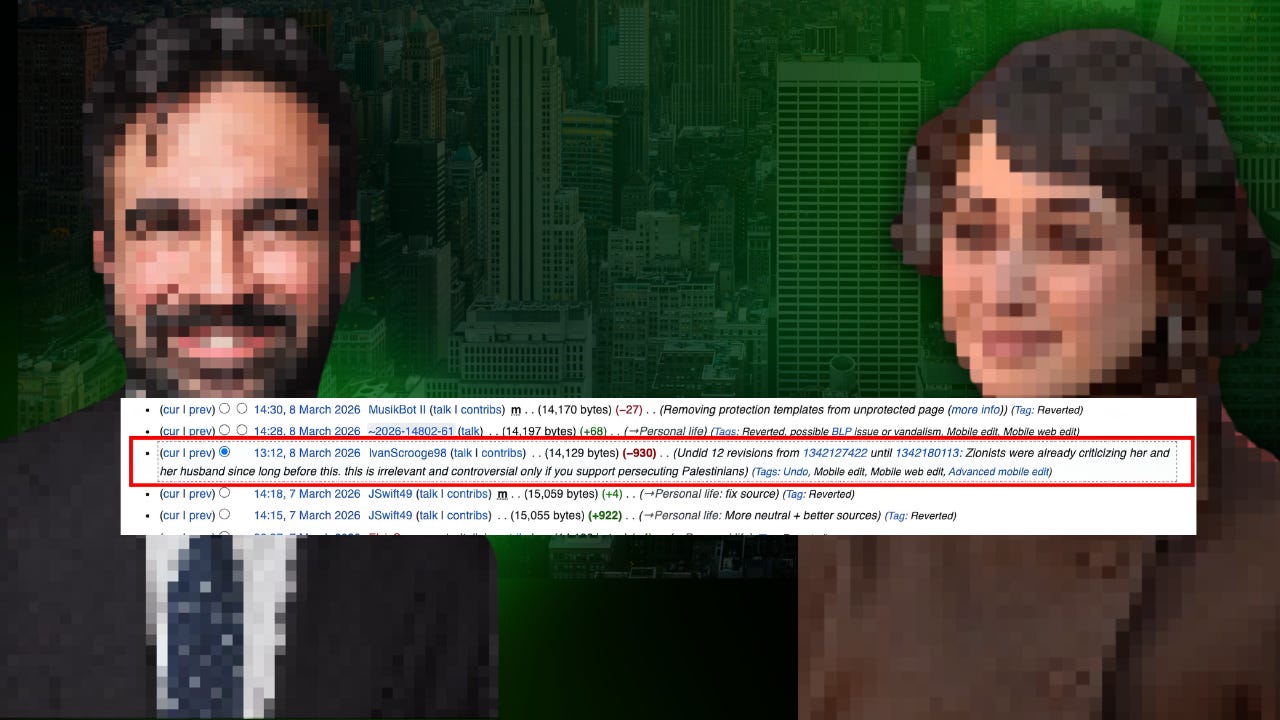
That dynamic becomes visible when you stop reading the article itself and start reading the edit history behind it.
The Wikipedia pages for Zohran Mamdani and Rama Duwaji offer revealing examples of how politically sensitive information is negotiated on the platform — not through a single act of deletion, but through dozens of smaller disputes over wording, sourcing, relevance, and tone.
At first glance, the pages appear relatively straightforward. The controversies are present. Readers can find references to Duwaji’s social-media activity after October 7, her past use of slurs, Mamdani’s music career, and criticism surrounding some of his rhetoric and political associations.
But the edit history tells a more complicated story.
Open the revision logs and the articles are no longer static. They become active battlegrounds: editors reverting one another within minutes, arguments unfolding across talk pages, accusations of bias appearing alongside appeals to Wikipedia policy. A sentence survives for a short period before disappearing. A source is treated as reliable in one context and insufficient in another. Even individual words become points of sustained dispute.
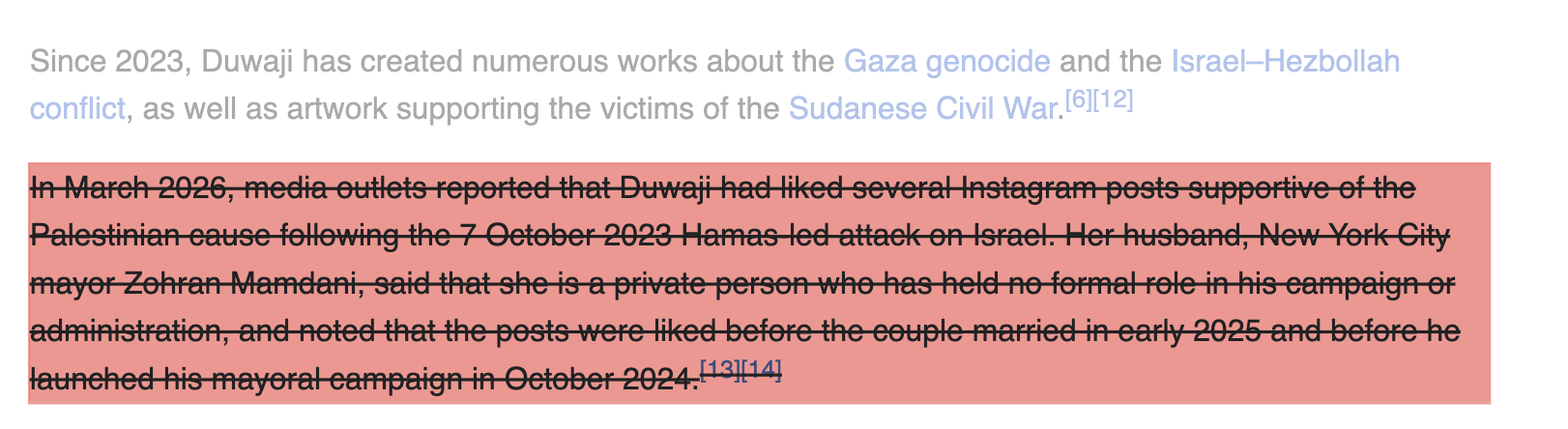
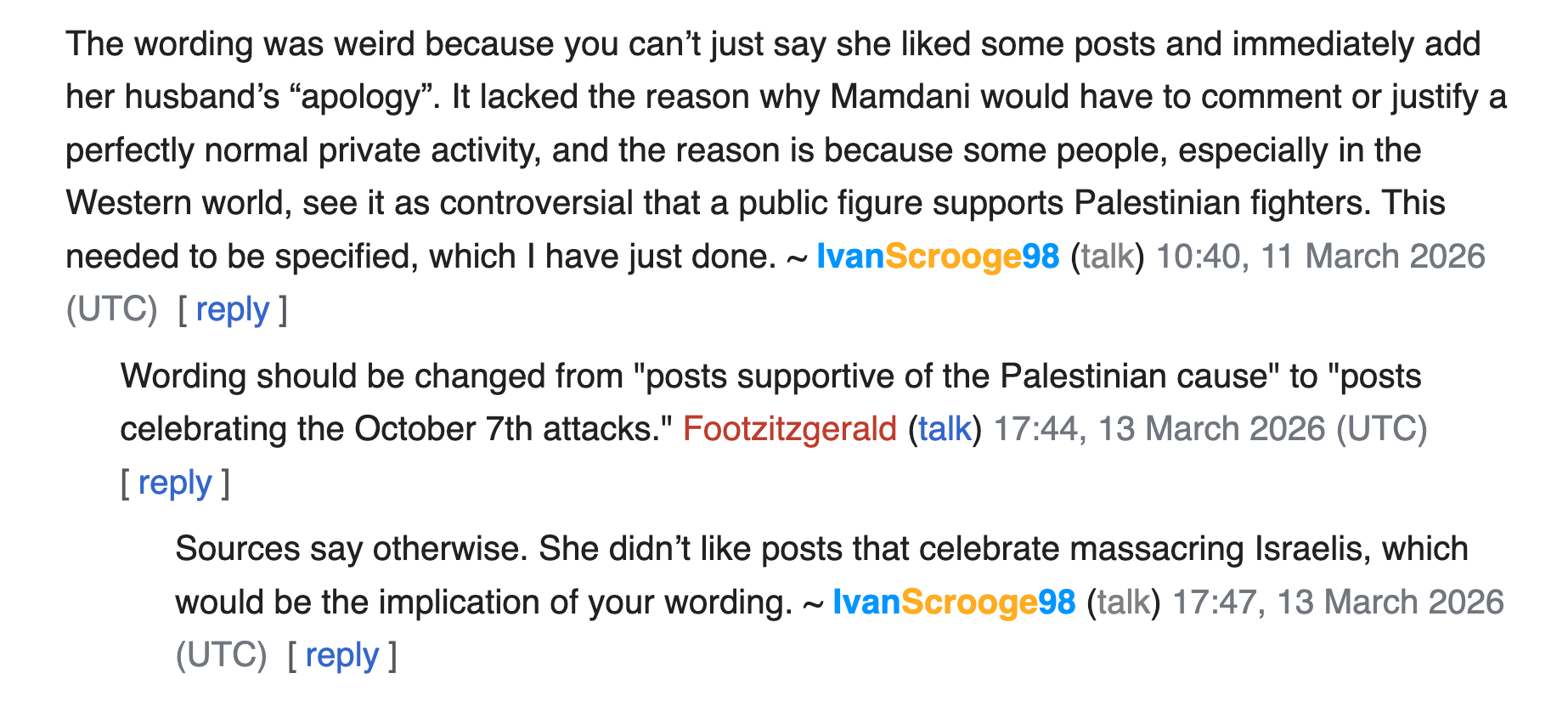
One recurring dispute centered on how to describe social-media posts liked by Duwaji after the October 7 attacks.
Some editors argued the posts should be characterized as celebrating the attacks. Others objected that such language imposed interpretation rather than describing the posts themselves. The disagreement ultimately turned on a familiar Wikipedia tension: how far language can move beyond observable behavior into inferred meaning.
This pattern becomes clearer when viewed across both articles together.
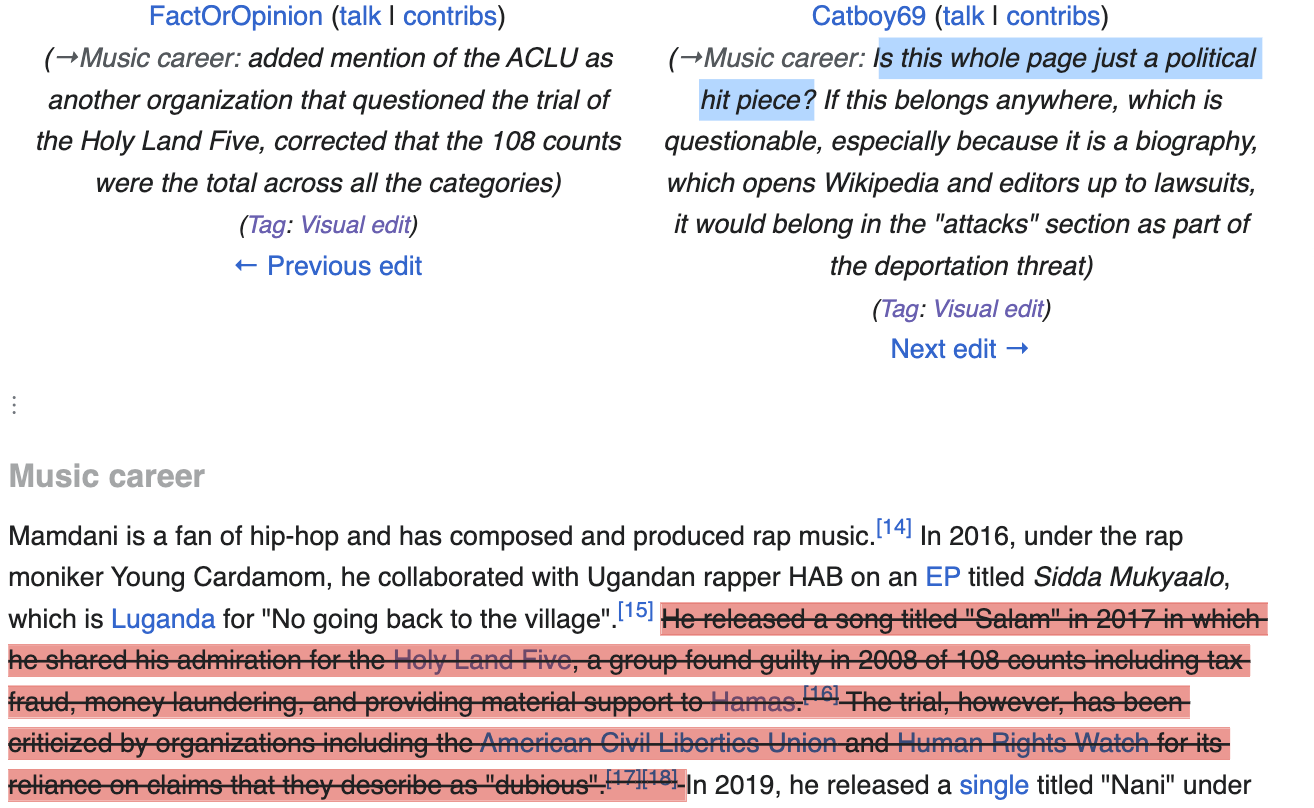
On Mamdani’s entry, editors spent weeks revisiting — across multiple Talk page threads and successive rounds of revision — how to frame references in his 2017 rap track “Salam” to the “Holy Land Five,” individuals convicted in the Holy Land Foundation case involving Hamas financing. At different stages, the material was removed as irrelevant, reintroduced with caveats, or reframed in more limited language that emphasized association rather than conviction or ideological framing.
On Duwaji’s page, a parallel dispute unfolded over how to characterize social-media activity following October 7. Editors disagreed not only on interpretation, but on what level of inference Wikipedia policy permits: whether “celebrating,” “supporting,” or “liking posts supportive of” constitutes neutral description or editorial judgment. Over time, the phrasing migrated away from specific and interpretive language toward broader, more procedural formulations tied to general political expression.
Taken in isolation, each dispute reflects standard Wikipedia governance: debates over sourcing quality, neutrality standards, and biography-of-living-person constraints. But taken together, they reveal a consistent structural tendency.
Contested claims rarely disappear. Instead, they are reworked through cycles of challenge and revision until they settle into forms that satisfy Wikipedia’s procedural constraints. What survives is not necessarily the most direct description, but the version of the description that can withstand sustained editorial scrutiny under policy constraints.
This produces a distinctive outcome. The underlying controversy remains visible, but its framing is progressively generalized. Specific assertions give way to broader categories. Interpretive language is replaced with descriptive proxies. Over time, the most precise formulations are often the least durable.
What emerges is not a resolution of meaning, but a filtration process: Wikipedia does not resolve disputes in a traditional sense, but narrows the range of language that can survive them.
To critics, Wikipedia’s output can appear as a form of ideological filtering. To defenders, it is simply the predictable result of enforcing neutrality through sourcing standards, procedural constraint, and editorial caution. Both readings capture part of the system, but neither fully explains its behavior at the level of individual articles.
Wikipedia’s editing culture is adversarial by design. Editors routinely challenge one another’s phrasing across thousands of politically sensitive pages, and many disputes that appear ideological from the outside are, internally, disputes over policy interpretation, sourcing hierarchy, and the limits of acceptable synthesis.
The result is not the absence of conflict, but its formalization. Contested claims are not resolved through authority or editorial judgment, but through procedural endurance — repeated challenge, reversion, and consensus-building under established rules.
Wikipedia’s policies reinforce this dynamic. Loaded language is discouraged unless explicitly attributed. Primary-source interpretation is constrained. Biographies of living persons are subject to especially strict sourcing thresholds. These rules are designed to reduce editorial bias, but in practice they also shape which forms of description are more likely to survive sustained scrutiny.
This becomes more visible when disputes accumulate around politically adjacent material.
On Mamdani’s page, for example, editors debated whether criticism related to his response to the phrase “Globalize the Intifada” warranted significant coverage or contextual framing within the article.
Individually, these debates are unremarkable. Wikipedia talk pages contain thousands of similar exchanges across political topics, all governed by the same procedural vocabulary of neutrality, relevance, and sourcing standards.
What distinguishes these cases is not their content, but their repetition. Across both articles, similar patterns emerge: more specific or interpretive language tends to be less stable than broader, more procedural phrasing. Direct characterizations are often challenged, while generalized formulations prove more durable.
That process is fully visible in Wikipedia’s revision history. Nothing is hidden in principle. The question is not access, but interpretation: how to read the accumulation of small editorial decisions that, over time, determine the final form of an article.
The final page presents a stable narrative. The revision history reveals how that stability is produced — not through resolution of meaning, but through repeated narrowing of language under procedural constraint.
In that context, what matters is not what disappears from the record, but the form in which what remains is ultimately shaped.
Wikipolitik
Wikipedia is a big political tug-of-war, as I know from presonal experience. (People don't know this. When I complained of Wikipedia's article on Creationism, a family member said, "Why don't you just change it then?" Naive.) For a couple of years I've had my own little tug-of-war in Wikipedia's article on the Joan Baez song, "Here's to You." As originally written, the article makes Sacco & Vanzetti sound like angelic victims of American bigotry and fitting subjects for the song's hagiographic tailoring. My "fix" humbly introduces the fact that their guilt has become more certain over time. Needless to say, my one little fix keeps getting obsessively reversed by Wikipedia lefties who seem to function as ever-vigilant guards in the snowy Wikipedia gulag.