



NPOV has completed a months-long analysis of the six leading editors of the Gang of 40 edit cluster. We present the findings here in a series of reports.
Since October 7, a group of around three-dozen editors, the Gang of 40, have succeeded in overturning just about every established fact about Israel, Palestine, Gaza, and the Jews.
They have turned Zionism into “ethnic cleansing” and determined that the Gaza war was, objectively a genocide. They have airbrushed Hamas’ 1988 charter that called for the eradication of Jews, deleted Hezbollah terror attacks, and whitewashed human rights abuses by the Iranian regime.
After my first report on the Gang of 40 came out, Wikipedia’s top “court,” ArbCom, undertook one of its biggest investigations in years in a case called PIA5—Palestine-Israel Articles 5. Those six editors—Nableezy, Nishidani, Iskandar323,Levivich, Makeandtoss and Selfstudier—spent years shaping Wikipedia’s coverage, making more than 320,000 combined edits across more than 3,700 entries.
Between November 30, 2024 and January 23, 2025, ArbCom examined editor conduct across Israel-Palestine articles. It imposed topic bans on eight editors. Not one edit was reversed by the proceeding. The tactics observed from NPOV’s own analysis include:
Surgical deletions of unfavorable points
A pattern of rotating co-editing among the group
Pressure to add, retain, or remove publications from Reliable Sources
Changes in name or terminology on sensitive topics
One of the clearest examples of why this latter points matters comes from Iskandar323. Between 2014 and 2024, the account conducted over a dozen documented “speedrun” campaigns, a kind of editorial blitzkrieg designed to upturn sensitive entries before others realize what’s taking place.
A May 2023 speedrun illustrates the approach. In less than 30 minutes, Iskandar323 made 25 edits across articles relating to the Kings of Ancient Israel and Judah. Similar campaigns targeted articles covering The History of Israel, the Siege of Jerusalem, Jewish communities and Iranian opposition groups, systematically altering related pages in quick succession.
These were not isolated cases. In other cases, Iskandar removed:
11,663 characters from the Holocaust Remembrance Alliance article in 21 minutes.
25,499 characters of criticism cut from the Amnesty article in 80 minutes.
14,318 characters from the Labour antisemitism article in one session.
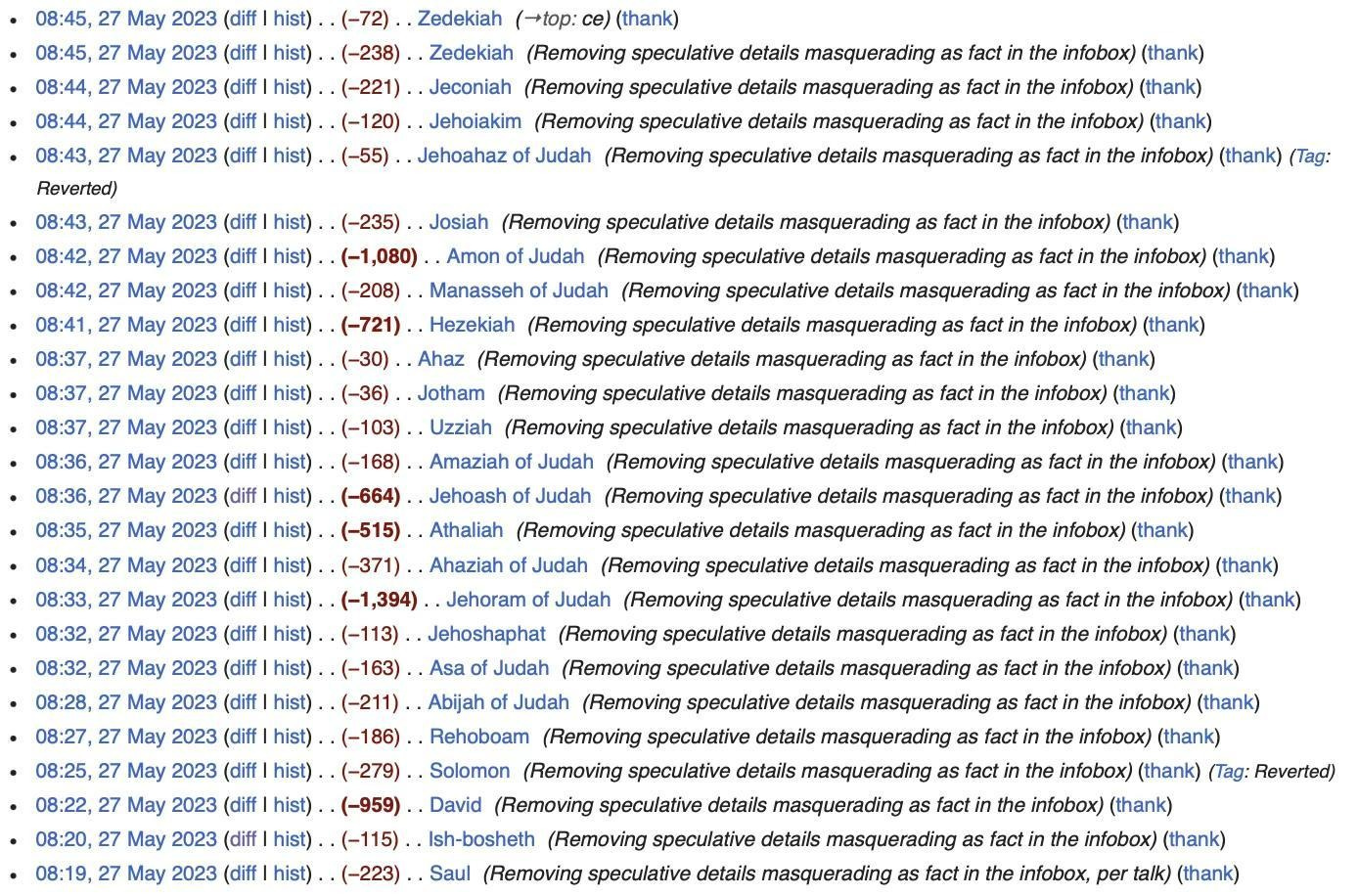
Viewed individually, each edit appeared routine. Viewed together, they revealed a method of reshaping entire clusters of articles before normal editorial oversight could catch up. The same principle appeared at the group level.
Editing Dynamics
Across the six accounts, we identified 63 distinct editor configurations. The six editors could co-edit entries in combinations of two, three, four and five editors repeatedly working across overlapping sets of articles.
Rather than operating as a fixed bloc, the group continually recombined. Two editors would appear on one dispute, four on another, three somewhere else. Such editing would help obscure coordination among the group.
The Edit Cluster by the Numbers
Nableezy and Iskandar323 jointly edited 1,463 articles.
Nableezy and Nishidani overlapped on 1,229.
Iskandar323 and Nishidani worked together across 1,032 articles.
Nableezy and Selfstudier overlapped on 903 articles.
Selfstudier and Iskandar323 overlapped on 856.
Nableezy, Nishidani and Iskandar323 all edited the same 595 articles.
All six editors converged on 64 articles.
On 168 entries, five of them edited together.
When three editors converged on a talk page, the arithmetic of Wikipedia’s consensus model shifted decisively in their favour. Consensus is ultimately a numbers game.
Arbitrators had already identified elements of this behavior at the individual level. In explaining a topic ban against Levivich, one arbitrator described an editor who would “participate in a tag-team edit war while selectively complaining about other people tag-team edit warring and trying to get them sanctioned for it.”
Edit Concentrations Defy Normal Patterns
The concentration of editing by these editors within PIA is similarly illustrative. While most editors with deep editing histories typically diversify their efforts over time, the Six became increasingly focused on this one topic area.
Selfstudier directed approximately 90% of all edits toward PIA.
Makeandtoss and Nableezy are both around about 83%
Nishidani devoted 65% of their edits to the same topic.
Levivich is 48% and Iskandar323 is 35%.
The nature of the edits also warrants closer examination. As mentioned above, the general strategy adopted by Gang of 40 editors is to make thousands of small, sometimes even apparently trivial edits to target entries.
But on some occasions—possibly those that warranted urgency on the editors’ part—the edits became flagrant. In these cases, editors would push for the radical, sometimes extreme, editorial outcomes to the most contentious entries no the most sensitive issues.
Flagrant Edits by the Six Gang of 40 Leaders
On October 7, 2023, while the attacks were still unfolding, Iskandar323 edited the Israel article to add criticism concerning Israel’s claims of universal suffrage.
On May 7, 2024, Nableezy removed a section from the Gaza war article describing the October 7 attack, including infiltration methods, attacks on military bases, the Nova music festival massacre, the taking of 251 hostages and reports of sexual violence. The edit summary described the change as procedural symmetry.
Three months later, they removed a sentence stating that systematic incidents of rape and sexual violence had been reported during the initial Hamas attack, together with its New York Times citation.
Nableezy deleted the “Denial of atrocities” section on the October 7 entry, saying the material was “accuracy.”
Nishidani turned “Hamas mutilated, tortured, killed and burned Israeli children” into “Hamas’s actions led to the death of 38 children” in the Children in the Israeli-Palestinian conflict entry.
On October 7, 2023, with the attack still underway, Iskandar323 moved the article on it from October 2023 Hamas attack on Israel to October 2023 Gaza−Israel conflict
Ideological Actors Shaping Wikipedia Governance
Wikipedia’s governance model assumes that bias introduced by one editor will eventually be corrected by another. It becomes far less reliable when the same editors who shape article content are also deeply involved in shaping the governance processes through which challenges to that content are resolved.
These six editors, in particular, did not merely alter article text, but accumulated extraordinary influence within Wikipedia’s internal governance. This notably includes the Reliable Sources discussions that determine which publications may be cited across the encyclopedia.
For example, Levivich argued against prohibiting citations to radical, pro-Hamas outlet The Electronic Intifada. Makeandtoss questioned the reliability of The Times of Israel. Nishidani repeatedly defended the reliability of Al Jazeera while dismissing other publications and institutions, including a NATO report and a German newspaper, as unreliable or politically compromised.
This was not simply a question of participation volume. ArbCom itself identified concerns about how sourcing processes could be used.
One arbitrator warned Levivich that if he used his skill “to selectively boost sources that agree with [his] position” keeping him in the topic area would be untenable.
The editors influencing articles were often participating in the very discussions that shaped the rules by which those articles would later be judged.
The Arbitration Committee found serious problems with how several of these editors operated. Arbitrators cited personal attacks, hostile conduct, coordinated edit warring and selective use of Wikipedia’s enforcement processes against other editors.
Those findings were serious enough to remove them from the topic area. But PIA5 ultimately addressed conduct. It did not examine the encyclopedia that conduct had helped create.
Most institutions recognize the distinction between investigating people and auditing their work. If accountants are suspected of misconduct, auditors do not simply remove them and leave the accounts they certified untouched. If concerns arise about aircraft safety, regulators do not investigate engineers without also inspecting the aircraft they approved. Yet in PIA5, Wikipedia concluded that editors had behaved improperly while leaving the encyclopedia they spent decades helping to shape almost entirely untouched.
One arbitrator warned Levivich that if he used his skill “to selectively boost sources that agree with [his] position” keeping him in the topic area would be untenable.
While the system judged the participants’ behavior, it never touched what actually matters: the finished product. Today articles not just shaped, but created and built by these banned editors continue to populate Google search results, inform journalists, train artificial intelligence systems.
Wikipedia has become part of the infrastructure through which modern societies establish shared facts. The post-Cold War era encouraged a powerful belief that open, collaborative systems would naturally become more accurate over time. Given enough independent participants, error would be identified, bias challenged and truth would gradually emerge.
The defining contests of the twenty-first century are increasingly fought not only on battlefields or in diplomatic chambers, but across the information systems through which societies understand reality. Search engines, collaborative encyclopedias, social media platforms and artificial intelligence have become part of the infrastructure that shapes public knowledge.
Governments, political movements, advocacy organizations and highly motivated volunteer networks all recognize that influencing those systems can shape public understanding long after events themselves have passed.
The full reports are available for down load below.
Full Report

Individual Editor Reports