


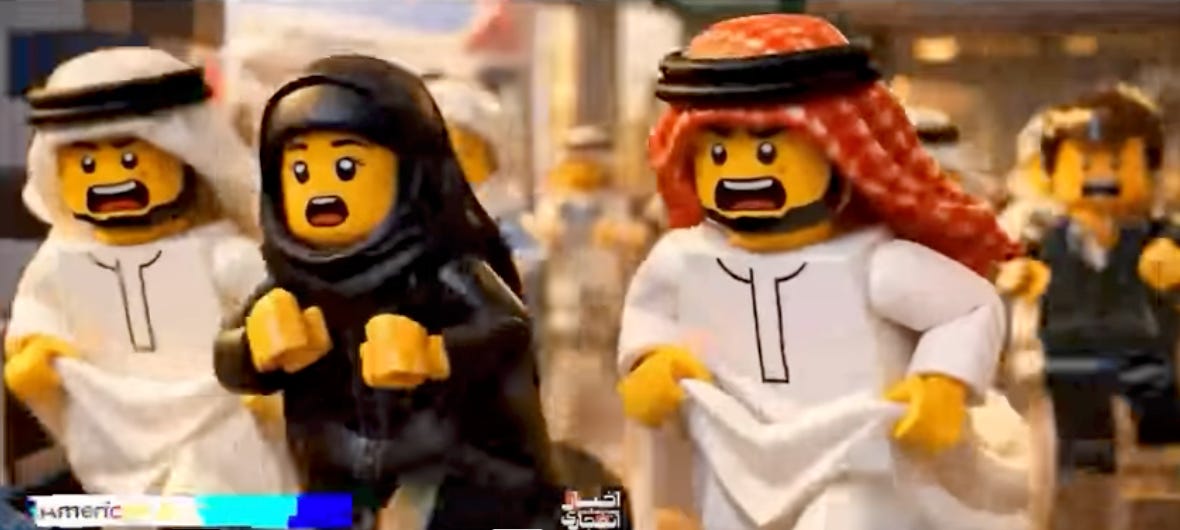
#1 Search rank for Lego IRGC video for “Iran” and Iran War”
+200,000 Iran state-linked files on Wikimedia Commons
0 Public statements from the Wikimedia Foundation
On March 16th, 2026, during an active communications blackout inside Iran, a Wikipedia editor uploaded a video to Wikimedia Commons.
It was produced by the Revayat-e Fath Institute, a cultural center funded by the Islamic Revolutionary Guard Corps titled “Iran propaganda LEGO AI video on 2026 Iran war.” Four weeks later and an hour apart, two further Lego style videos were uploaded to the site produced by Explosive Media, a company whose clients include the Islamic Republic of Iran.
By the opening weeks of the war, the videos were appearing widely across X, TikTok and have since been viewed hundreds of millions of times. They mock American leaders, glorify the IRGC, and are set to rap music. The BBC, New Yorker, Guardian, Al Jazeera and France 24 have all covered them—in doing so, amplifying their reach further.
But with the uploads to WikiCommons, the Iranian videos would become etched into our knowledge infrastructure—foreign propaganda hosted by a US-based 501(c)3 non-profit organization. A platform that touts itself for providing neutral information to the world, now leveraged as part of a mass-scale psychological operation staged by a country the US is at war with.
In addition to national security concerns, the content very likely constitutes an infringement on the IP of LEGO. NPOV reached out to LEGO for comment, no response was received by the time of publication.
State propaganda appearing online is not new. Governments do it constantly. What felt different here was where it landed—inside an infrastructure most people still experience as neutral, archival and vaguely untouchable. As the edit histories expanded, the same accounts continued appearing across seemingly separate parts of the ecosystem.
Search “Iran war” on Wikimedia Commons, filter by video, sort by relevance and the Lego video ranks first. Search “2026 Iran war” and it appears near the top again. Within days, Iranian state channels were circulating it as wartime messaging—distributed through infrastructure that Wikipedia’s global readership generally experiences as neutral archival media.
The account that uploaded the first Lego video is User: VitoxxMass. They are not a fringe contributor. VitoxxMass is one of the three most active editors on the English Wikipedia article for the 2026 Iran War—the version read by hundreds of millions of people worldwide. The logs tell us that their first edit was February 2025- by March 2026, they were uploading IRGC-produced wartime media during an active internet blackout inside Iran.
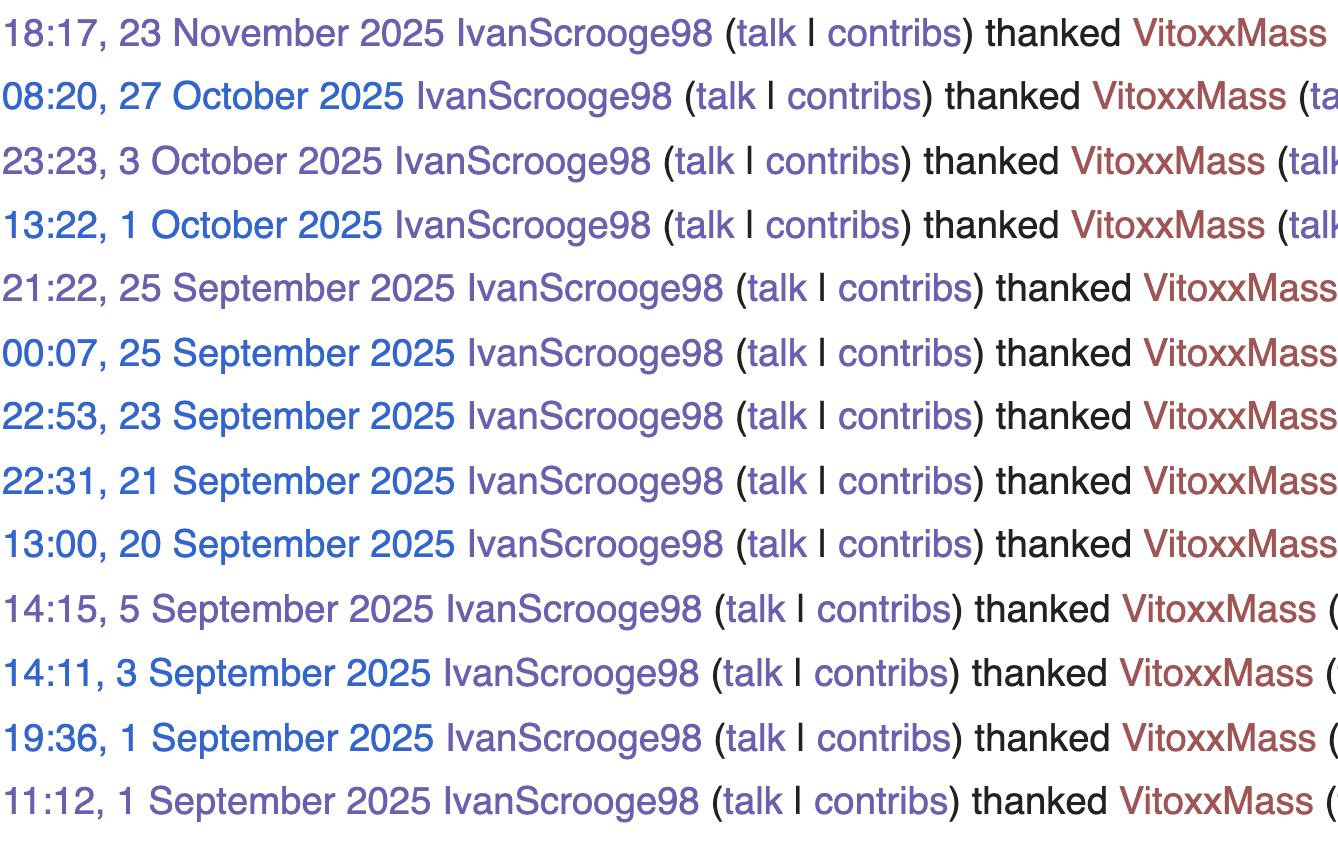
VitoxxMass also worked directly with IvanScrooge98, an editor NPOV previously documented removing Holy Land Five terror-finance references from Zohran Mamdani's page, scrubbing October 7 controversies from Rama Duwaji's article, and stripping the categories "murderer" and "terrorist" from a Commons image of Che Guevara. Commons talk pages, edit histories, and Wikipedia’s own logs document repeated interaction between the accounts while collaborating on the 2025 Global Sumud Flotilla page and the Gaza flotilla-related mapping projects.

One page brings the overlap into sharper focus: the article for Explosive Media itself. Controlling nearly 50% of the article is Mhhossein, a prolific pro-regime editor and member of Wikipedia’s “Gang of 40,” a coordinated network responsible for 850,000 edits to 10,000 articles, completely reshaping the PIA (Palestine Israel articles) topic area. A previous report titled “Inside Irans Wikipedia War” identified Mhhossein as a key editor involved in sanitizing Iran’s human rights record, made more than 11,000 edits across 2,228 pages.
On May 9th and 11th, 2026, Mhhossein expanded the article’s “Content analysis” and “Reception” sections, using Al Jazeera as a source to explain why Explosive Media had been banned by YouTube. Iran's Foreign Ministry had called that ban a move to suppress "the truth." Mhhossein also actively distributed the group's content on Wikimedia Commons by uploading two Lego-style propaganda videos produced by Explosive Media on May 29, 2026. He uploaded the first file, titled "Lego video by Explosive Media for Josh Rushing" at 14:26. Just 27 minutes later, at 14:53, he uploaded the second file titled "Nothing but WAR-Iran Lego-style videos.webm"
Two more editors appear in the logs. Mellangoose and MarissaTRS uploaded Explosive Media’s LEGO videos to Wikimedia Commons within 24 hours of each other. Both edited the Wikipedia article about Explosive Media—the same organisation whose videos they had just uploaded. Individually, each action can be explained away as ordinary Wikipedia maintenance. Taken together, the pattern becomes harder to ignore. The same cluster of editors repeatedly appears at every stage of the information chain: uploading the videos, embedding them into Wikimedia Commons, editing the pages connected to the organisations behind them, then shaping the explanatory narrative surrounding the media itself. The same videos appear elsewhere. On YouTube, a channel called AI IRAN has accumulated 3.6 million views across five videos. It carries a cryptocurrency donation link.
The videos drew attention first. The upload history revealed something much larger.
In February 2026, an editor known as Ladsgroup posted an alarm at the Commons Village Pump, Wikipedia’s central policy forum:
Anyone can upload anything at any scale. No one reviews it on arrival. If a volunteer happens to notice and has the energy to fight a deletion request — which they may lose — something might get removed. If not, it stays.
The figures suggested something far larger than isolated uploads.
~50,000 images from Mehr News Agency, a semi-official news agency owned by the government of Iran.
~52,000 from Fars News Agency, an IRGC-linked outlet
~63,000 from Tasnim News Agency, IRGC-owned & US-sanctioned
Thousands from former Supreme Leader’s official website Khamenei.ir.
The next day, an administrator warned the uploader and suggested slowing down, but no enforcement followed and the account remains active as do the files. One editor participating in the Village Pump discussion summarized the asymmetry directly: the Iranian state can mass-produce and openly license enormous volumes of media at effectively no cost, while independent protesters documenting the same events face censorship, imprisonment, or worse.
User:999real, uploaded the files while the Iranian regime was violently suppressing its own people. Nobody reviews uploads at this scale. 999real later admitted posting the material "in a hurry."
» March 16th – VitoxxMass uploaded the IRGC-linked LEGO video during the wartime blackout. Within days, Iranian state channels were redistributing it.
» April 13th – Two more propaganda-style LEGO videos funded by Islamic Republic of Iran entered Commons through separate accounts. There is no indication in the public logs that the uploads prompted a wider review.
» April 19th – Video was added to Explosive media Wikipedia page by the same account.
» May 10-13th – Mhhossein tied to the same overlapping cluster helps shape the explanatory narrative around the organization responsible for the April uploaded videos.
Through all of this, the Wikimedia Foundation has said almost nothing publicly. No broad review. No systemic response. No explanation for how a volunteer infrastructure built for open knowledge became capable of absorbing more than 200,000 state-linked media files with effectively no meaningful oversight.
Wikimedia Commons does not function as isolated storage. Its files flow directly into Wikipedia articles across hundreds of languages. Two of the Lego videos are already embedded into Irish Wikipedia Article “The US and Israel's war against Iran”. From there, the material becomes part of a much wider information ecosystem. Files uploaded to Commons rarely remain confined there; they flow outward into Wikipedia articles, search results, mirrors, archives and datasets relied upon by search engines and AI systems. The Wikimedia Foundation has made no public statement and the files remain.
The IRGC didn't need to breach Wikipedia. The system was already there.
https://grokipedia.com/
FTW
I would th I no that Lego would be very upset to have their product used as an incitement to violence.