

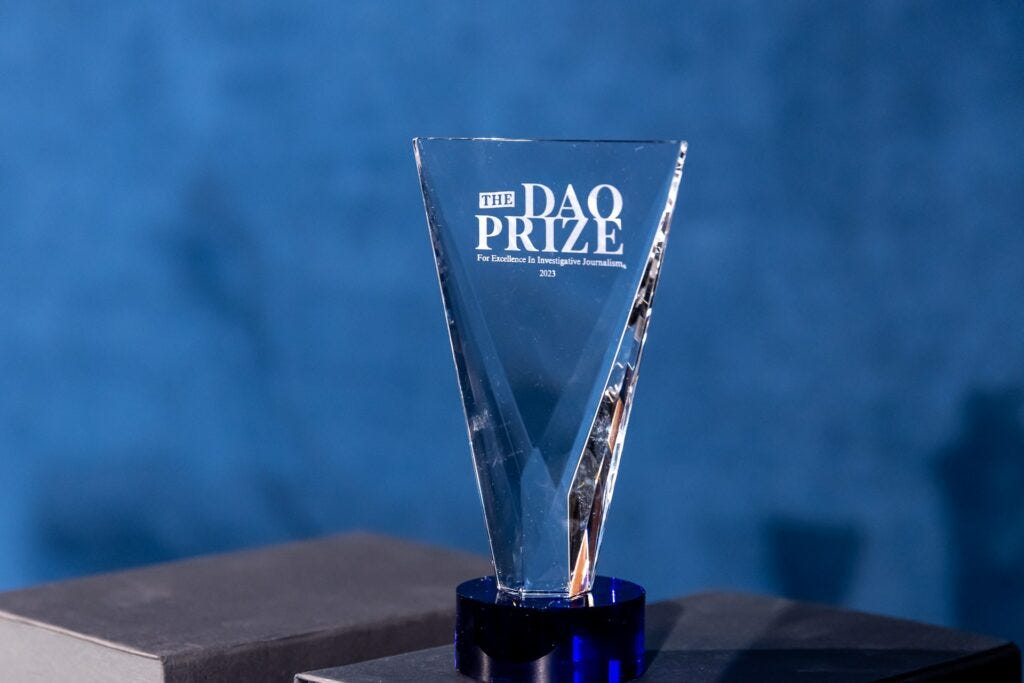
The DAO Prize has named NPOV founder and chief investigative officer Ashley Rindsberg as runner-up for its 2025 Grand Prize, awarding $10,000 for his coverage at Pirate Wires (Pirate Wires) on “The Ideological Capture of Wikipedia.”
Rindsberg had been selected earlier as a finalist for Best Overall Reporting or Series alongside major investigative teams at leading news outlets.
The DAO Prize was established to honor investigative journalism that demonstrates depth, public interest, fairness and accuracy, style, and impact. The Prize is awarded by the National Journalism Center.
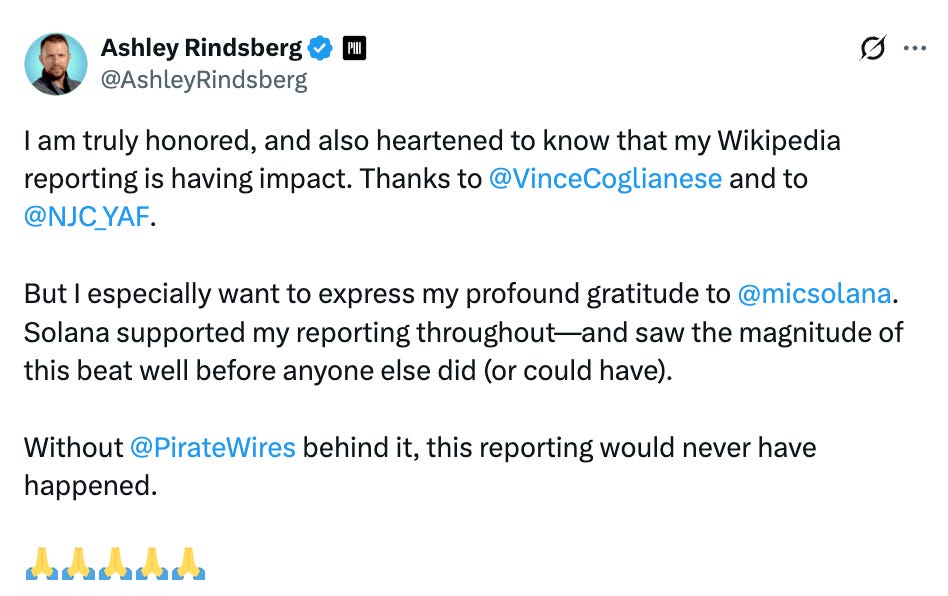
Rindsberg wrote on X:
I am truly honored, and also heartened to know that my Wikipedia reporting is having impact. Thanks to Vince Coglianese and to the National Journalism Center. But I especially want to express my profound gratitude to Mike Solana. Solana supported my reporting throughout—and saw the magnitude of this beat well before anyone else did (or could have). Without Pirate Wires behind it, this reporting would never have happened.
Rindsberg’s Pirate Wires series, which NPOV will be amplifying and building on, follows three main threads.
The first is ideological capture. In his reporting on internal battles around the 2019 “Fram” scandal and the rise of social-justice governance inside the Wikimedia Foundation, Rindsberg traces how power at Wikipedia has shifted from a decentralized community of volunteer editors to a professionalized NGO hierarchy. That hierarchy increasingly sees neutrality as a relic of “white supremacy” and pushes the site toward explicit activism. The Fram affair, the launch of WikiProject Black Lives Matter, and the broader DEI turn at the Foundation become, in his telling, a case study in how a knowledge infrastructure gets repurposed for a new ideological regime.
The second thread is the pro-Hamas and broader pro-Palestinian editing campaigns that have transformed the Israel-Palestine topic area. Drawing on months of forensic work inside Wikipedia, Rindsberg documents how a tight network of roughly forty veteran editors has, over several years and especially since October 7, worked systematically to delegitimize Israel, soften or sanitize coverage of Hamas, and elevate fringe anti-Zionist scholarship into apparent consensus.
The reporting shows how this network operates in small clusters to avoid detection, uses policy jargon to outmaneuver opponents, and quietly rewrites thousands of pages—often contributing more than 90 percent of the content on key entries. In parallel, he details how the Tech for Palestine Discord group attempted to coordinate mass edits across more than 100 articles, even using Wikipedia as pressure on British MPs over Gaza. The consequence is that concepts like “Zionism as settler colonialism,” once marginal, now sit in first position on Google with Wikipedia’s authority behind them—reshaping what millions understand about the conflict.
The third pillar is the pay-to-play economy that has grown up around Wikipedia’s outsized influence. In his investigation into black-hat and white-hat “Wikipedia firms,” Rindsberg shows how a sprawling global industry now markets article creation, reputation laundering, and deletion services to everyone from mid-tier entrepreneurs to Fortune-500 companies.
He follows the trail from early, openly declared paid editors like Gregory Kohs, through Pakistani operations to major Western PR and ad agencies whose staff manipulated or quietly gardened client pages. At the high end, he describes the rise of elite white-hat boutiques that scrupulously obey disclosure rules while shaping some of the most economically and politically sensitive pages on the site. The result is a platform that looks less like an encyclopedia and more like a vast, semi-regulated reputation exchange.
Launched in October, NPOV was born out of a belief that control over information architecture — who writes history, who edits facts, who defines context — is among the most consequential arenas of power in the digital age. The DAO Prize recognition for Rindsberg’s work provides external validation that this belief reflects a real need.
Subscribe to NPOV to help us further this important mission.
Congratulations!!! Well-earned!!