


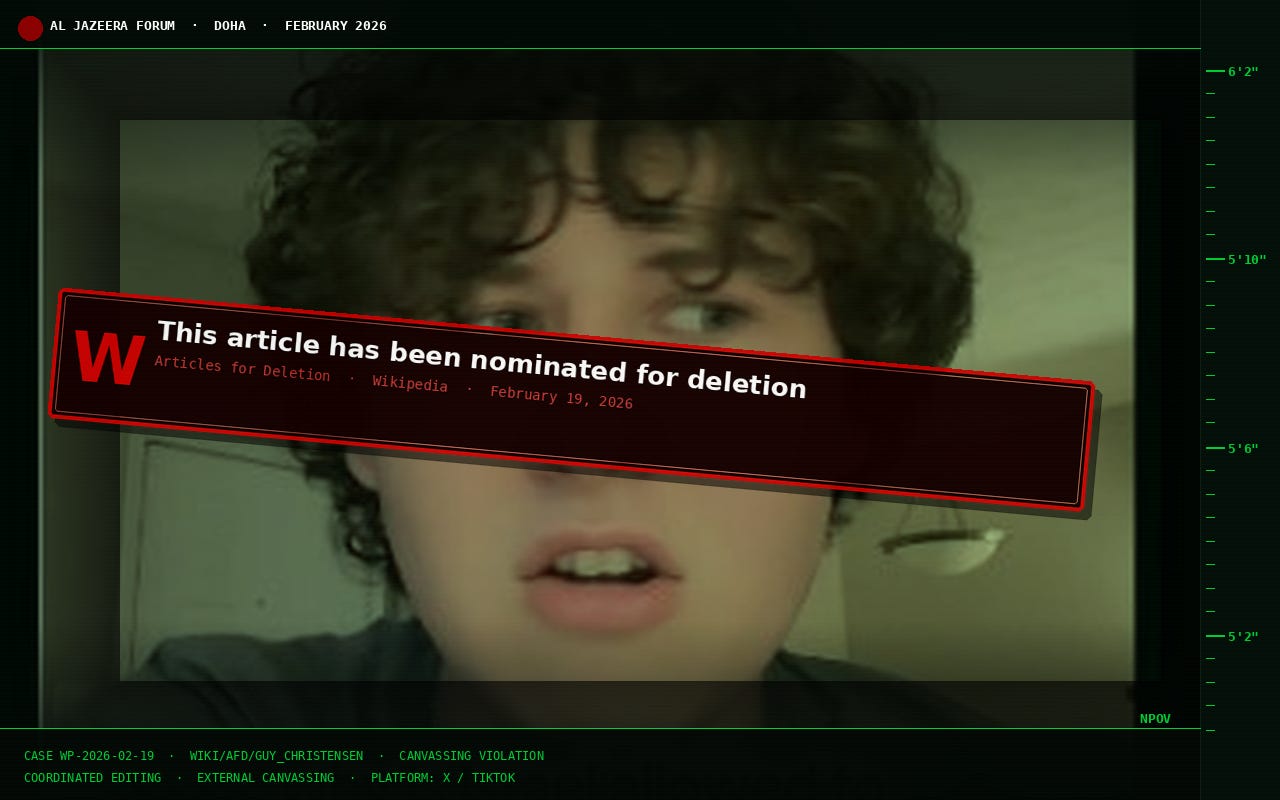
Guy Christensen has three million followers and a simple theory of information warfare.
“We are soldiers in this digital battleground,” he told an audience at the Al Jazeera Forum in Doha in February 2026. “And we need to act as such.”
Christensen, who posts on TikTok and X as YourFavoriteGuy, is one of the most widely watched English-language commentators on the Israel–Hamas war on TikTok. His videos regularly draw hundreds of thousands of views.
On the same day that he delivered his remarks in Doha, warning about what he called Israel’s “eighth front” of digital warfare and pointing to efforts to influence Wikipedia’s coverage of Palestine, a Wikipedia article about him was nominated for deletion.
This set off a chain of events that illustrates how digital manipulation takes place online, and the extent to which actors behind this manipulation are able to coordinate across platforms—and even openly admit to, or call for, coordination of this kind.
On February 7, an entry on Wikipedia titled Guy Christensen was created. At that moment, Christensen was either on his way to—or already in—Qatar, where two days later he was slated to appear at the Al Jazeera Forum in Doha, an annual conference hosted by the Qatar government-controlled broadcaster, Al Jazeera.
This nexus between Qatar, Al Jazeera, and Wikipedia is highly significant. In January, The Bureau of Investigative Journalism (TBIJ) broke a major story detailing how, for over a decade, Qatar paid a London PR firm called Portland Communications thousands of dollars to edit Wikipedia pages on behalf of the Qatari government.
TBIJ reported on Portland subcontracted much of this Wikipedia work for the Qatari government to firms that specialize in editing on the site:
Portland’s subcontractors have polished the public image of Qatar by burying references to critical reporting ahead of the 2022 World Cup, according to the firm’s insiders. They have also obscured mentions of a major terrorist-financing case involving Qatari businessmen; scrubbed evidence that a billion-dollar Gates-funded project failed in its mission; and promoted one side of Libya’s post-Gaddafi government over the other.
Less than a month after that story broke, Christensen was at the Al Jazeera Forum, where he laid out his view of digital activism. Platforms, he argued, are not neutral venues for the exchange of information. Rather, he said, they should be seen as battlefield terrain.
“This is war online, of activism,” Christensen said during his panel talk. “We are all engaged online. The things we say about Palestine, criticism of Israel online—even if you are not posting, if you are engaging, you are participating in this war.”
Christensen identified Wikipedia explicitly as one of the major fronts in this ideological conflict.
His panel at the Forum event was titled, “Sources of Influence: The Creator, Content, Platforms and Funding.” Within hours of the panel, a Wikipedia editor operating under the account name Butterscotch Beluga nominated the Guy Christensen article for deletion through the site’s Articles for Deletion process, the community mechanism used to determine whether a page meets Wikipedia’s notability standards.
The editor’s activity history shows substantial work in the Israel–Palestine topic area, one of the most contentious domains on the platform. Across dozens of highly contentious Middle East articles, the account routinely sanitized terminology, downplayed events unfavorable to Palestinians, challenged pro-Israel sources, and aggressively policed other editors. In effect, it operates less as a neutral editor and more as a gatekeeper, controlling both language and sourcing to maintain a consistent framing on one side of the conflict.
The motion to delete Guy Christensen’s article was defeated.
(Christensen did not respond to NPOV’s outreach.)
It’s unclear whether Christensen played a role in the effort to have the page removed the first time. But he began publicly canvassing for assistance from editors. On February 12, Christensen posted an appeal on X:
If any Wikipedia editors follow me please DM me. I have a favor to ask.

Whatever DM discussions might have ensued, they apparently were not effective in providing the outcome Christensen was seeking. A week later, on February 19, Christensen posted on X once again. This time he linked his now public campaign to have his article deleted to the broader conflict:
“Zios have overrun and are holding my Wikipedia page hostage like they hold Palestinian children hostage. If there are any Wikipedia editors who stand with humanity I would appreciate it if you were to combat the Zios.”
In Wikipedia terminology, this kind of attempt to recruit editors to sway editorial decisions in a certain direction is known as canvassing, and it is generally prohibited under the site’s complex matrix of rules, guidelines, principles, and best practices.
Wikipedia editors took note of this effort.
On February 28, an editor added a banner to the top of the article’s Talk page alerting editors that participants may be recruiting outside support for a discussion. The banner warned that “there have been attempts to recruit editors of specific viewpoints to this article” and reminded participants that Wikipedia disputes are resolved through consensus rather than majority votes.

While this was standard operating procedure in a situation like this one, other, more unusual activity appeared as well.
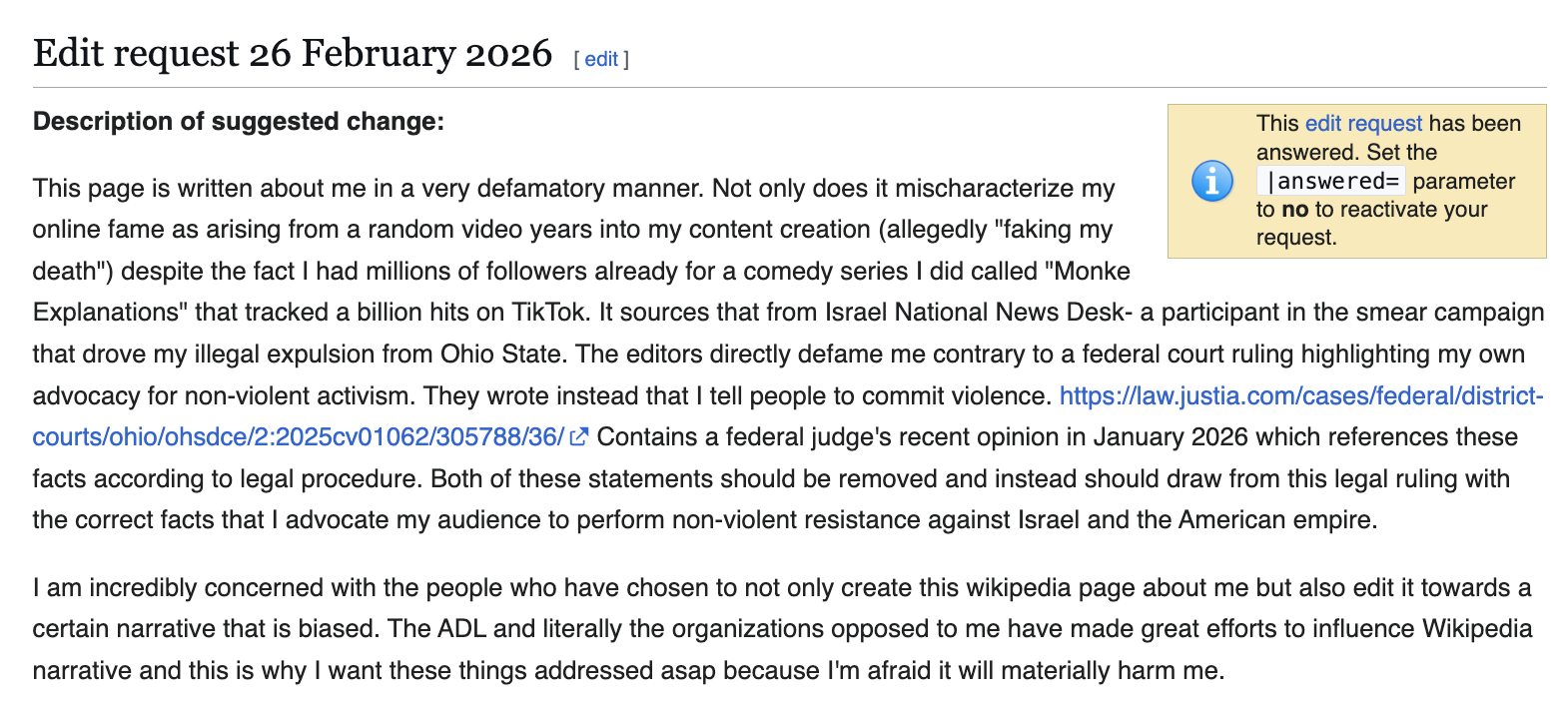
On February 26, an account identified in the revision log as ~2026-12764-69, with only three recorded edits—all related to the Christensen article—appeared on the Talk page stating that the editor was Christensen himself. The account argued that portions of the article were “defamatory” and submitted edit requests seeking the removal of these elements.
This page is written about me in a very defamatory manner. Not only does it mischaracterize my online fame as arising from a random video years into my content creation (allegedly "faking my death") despite the fact I had millions of followers already for a comedy series I did called "Monke Explanations" that tracked a billion hits on TikTok.
Echoing Christensen’s panel remarks in Doha, where the TikToker alleged that ADL head Jonathan Greenblatt had led pro-Israel online information efforts, the anonymous Wikipedia editor claiming to be Christensen accused the “ADL and literally the organizations opposed to me” of going to “great efforts” to influence Wikipedia against him. “This is why I want these things addressed asap because I’m afraid it will materially harm me,” the account wrote.
Christensen’s remarks about coordinated Wikipedia editing, which he made in Doha, were ironic, given the reporting that surfaced only weeks prior about Qatari paid editing. But even more to the point was that Christensen himself is allied with one of the only groups to ever have been caught coordinating ideological Wikipedia editing off of the site.
The Gang of 40 and Coordinated Editing
In October 2024, I published a piece in Pirate Wires on systematic pro-Hamas Wikipedia editing conducted mostly by a group I later identified as the Gang of 40. In that same investigation, I also identified a separate coordinated editing group which was part of an 8,000-member Discord server called Tech For Palestine.
A separate but complementary campaign, launched after October 7 and staged from an 8,000 member-strong Discord group called Tech For Palestine (TFP), employed common tech modalities — ticket creation, strategy planning sessions, group audio “office hour” chats — to alter over 100 articles. Operating from February 6 to September 3 of this year, TFP became a well-oiled operation, going so far as to attempt to use Wikipedia as a means of pressuring British members of parliament into changing their positions on Israel and the Gaza War.
Much of the Wikipedia coordination on the TFP Discord server was initiated and led by notorious pro-Hamas propaganda account, Zei_Squirrel. In subsequent reporting, we identified how Zei_Squirrel canvassing and social media activities across not just Wikipedia but also X/Community Notes, Reddit, Instagram and other platforms. Christensen would likely have been familiar with this activity.
Just two weeks before his appearance at the Al Jazeera Forum, he appeared as a speaker at the Tech for Palestine Tech Summit in Mountain View, California. The event, which founder Paul Biggar describes as “the largest gathering at the intersection of tech and pro-Palestine advocacy,” brought together engineers, activists, and political organizers from across the movement. Among the event’s “Gold” sponsors was the Council on American-Islamic Relations (CAIR), the same organization named by federal prosecutors as an un-indicted co-conspirator in the Holy Land Foundation trial, the largest terrorism-financing case in the U.S. history.
The summit’s speaker lineup also included Basim Elkarra of CAIR and Issam Hijazi, co-founder of the social network UpScrolled, which is backed by the Tech for Palestine incubator.
Christensen heavily promoted UpScrolled, describing it to followers as offering “no censorship” and freedom from billionaire ownership — a characterization later added to the platform’s Wikipedia article by editor Isi96. During the same period, the same editor expanded the page’s “Reception” section, adding praise from CAIR alongside a quote from Christensen himself describing the platform.

In post after post throughout January 2026, Christensen urged his followers on X to migrate to the platform.
UpScrolled is supported by Tech for Palestine, placing the platform within the same organizational ecosystem that hosted the summit where Christensen appeared as a speaker. Seen in that context, Christensen’s later defense of Wikipedia’s neutrality sits uneasily beside his own description of the internet as a battlefield.
In 2025, a committee in the United States House of Representatives opened an investigation into allegations of systemic anti-Israel bias on Wikipedia. This month, Christensen responded in a widely circulated video posted to TikTok and YouTube.
In the video, Christensen promoted a conspiracy theory about "Zionists in the administration” attempting to pressure Wikipedia into adopting what he described as a pro-Israel narrative. For the first time, he said, he was considering donating to Wikipedia in order to defend it. The framing positioned Christensen as a defender of Wikipedia’s neutrality. The record reveals something far more complicated.