


Over the past decade, salaries at Wikimedia Foundation (WMF), the non-profit that owns and operates Wikipedia, have soared to record highs.
While the non-profit runs banners on the site asking users for $3 donations to keep “knowledge free,” its leadership has presided over a compensation explosion that defies the modest norms of the charitable sector.
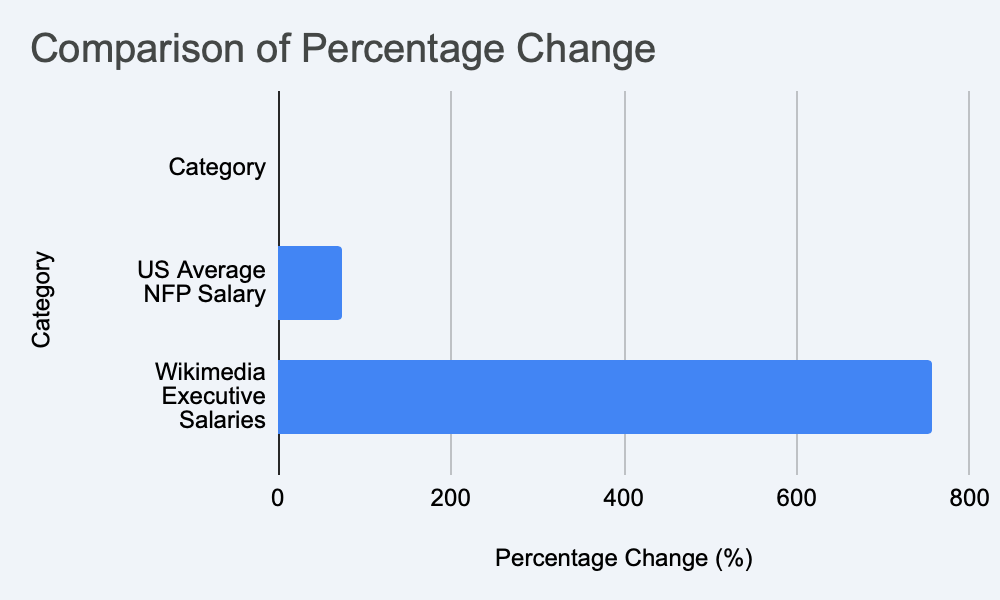
An NPOV analysis shows that between 2011 and 2023 (the year most recent data is available), WMF executive salaries soared 756%—compared with around a 66% rise in average salaries in the US for the same period.
Our findings show that, a number of WMF executives took home in excess of $1 million over a five-year period, with the non-profit’s former executive director, Katherine Maher, bringing home a total of $2.2 million between 2017 and 2022.
This puts WMF executives above the 95th percentile of US wage earners, according to the National Equity Atlas.
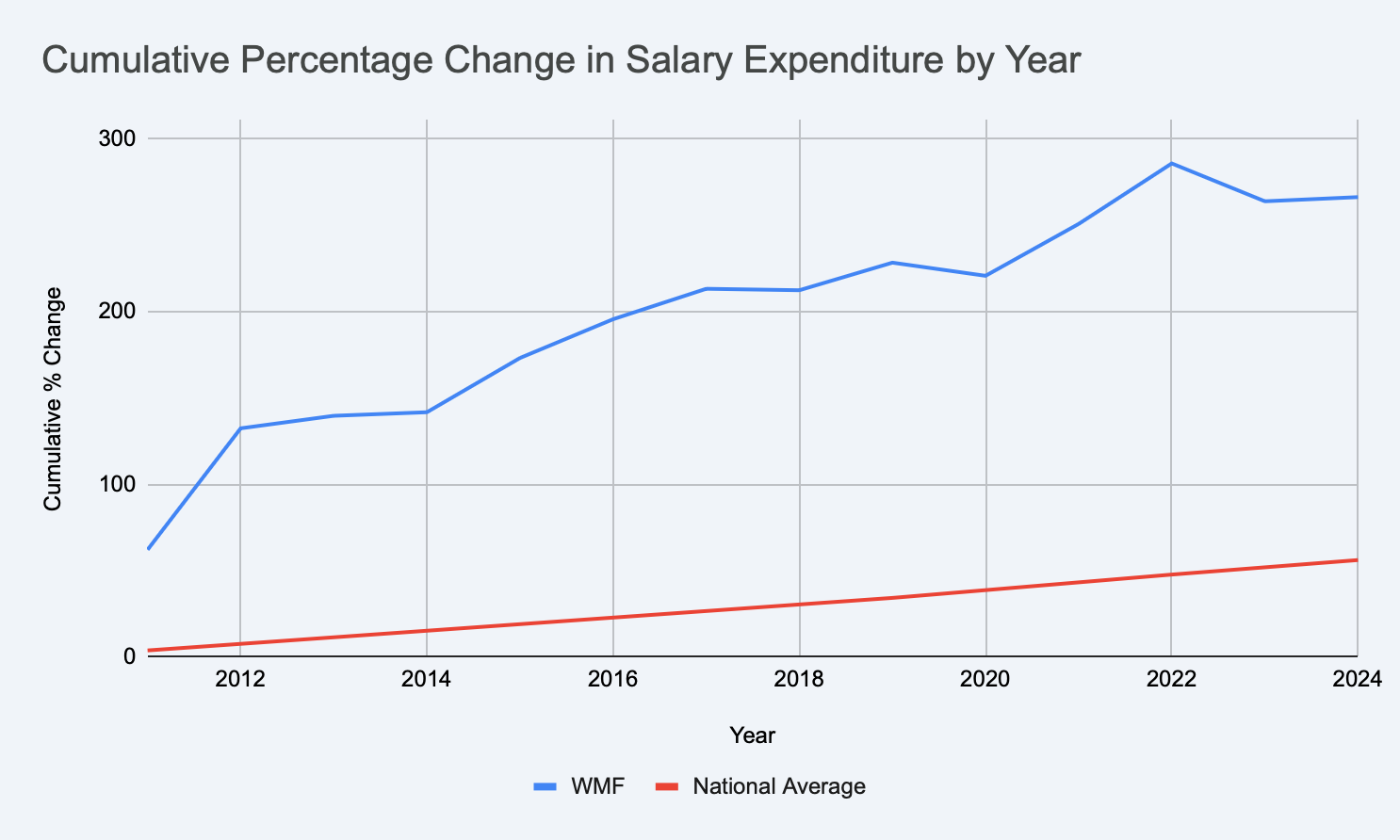
WMF’s finance department has followed a similar, if steadier, ascent; the Chief Financial Officer’s pay has reliably surpassed the $400,000 mark since 2022, ending the most recent fiscal year at $438,216. While the average US non-profit saw salary expenditures rise by a standard 3–4% annually, Wikimedia’s executive pay scales have frequently jumped by double digits.
WMF did not respond to a request for comment for this story.
While WMF begs users for $3 donations to keep the world’s knowledge free, its leadership has presided over a compensation explosion.
By far, the standout in this trend is former WMF executive director and CEO, Katherine Maher, whose compensation in 2021 was an astonishing $798,632, including a $623,286 severance payment. Given that, according to a WMF announcement Maher “stepped down,” it’s unclear what the severance was for.
Maher’s golden parachute is far from an isolated case. The year she left, WMF paid out $1.2 million in total severance payments, including $324,000 to outgoing COO Janeen Uzzell, who had only been at WMF for two years when she left.
A review of the most recent tax filings (for fiscal year 2023) reveals a C-suite accumulating massive annual compensation packages for standard 40-hour workweeks:
Maryana Iskander (CEO): $494,079
Selena Deckelmann (Chief Product & Technology Officer): $478,232
Jaime Villagomez (CFO): $438,005
Lisa Seitz Gruwell (Chief Advancement Officer): $388,366
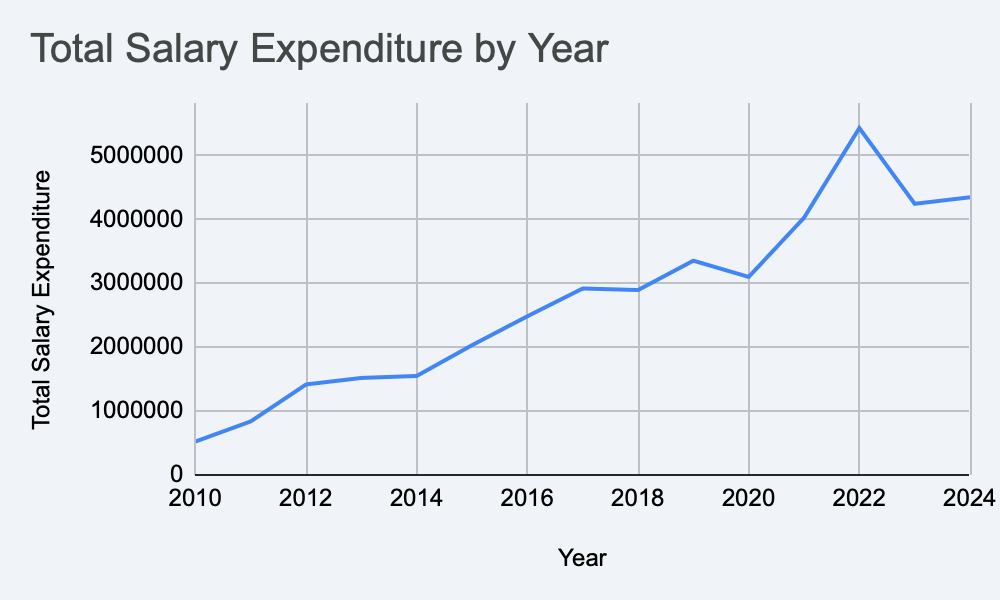
In the fiscal year ending June 2024, WMF’s total expenditure on salaries and wages hit a record $102,027,791.
While it could be argued that these salaries reflect market rates for executives at leading NGOs, this doesn’t stand up to analysis. In 2023, international aid organization Save the Children reported total revenue of $919 million—around five times the size of Wikimedia’s $185 million revenue.
Despite managing an organization 500% larger and far more logistically complex, the CEO of Save the Children received $629,195 in total compensation. Wikimedia’s CEO, Maryana Iskander, earned $494,079—roughly 78% of the pay for managing a fraction of the responsibility. (Iskander earned $538,000 the previous year.)
The Chief Development Officer at Save the Children, responsible for a machine that brought in over $910 million in grants and contributions, received a total compensation of $383,814 in fiscal year 2023. In contrast, Wikimedia’s Chief Advancement Officer, Lisa Seitz Gruwell, received $411,000 in the same year—a 7% premium over the same position at Save the Children.
Comparison with another globally significant NGO tells the same story. The Sierra Club reported $173 million in revenue in fiscal year 2023, in line with Wikimedia’s $185 million. Yet, the Sierra Club’s Chief Financial Officer received $324,272 in total compensation, while Wikimedia’s CFO collected $436,216—a 34% premium over Sierra Club’s compensation for the same role.
The disparity widens in fundraising, where the Sierra Club’s Chief Advancement Officer earned $288,569, meaning Wikimedia’s Seitz Gruwell earns 40% more than her Sierra Club counterpart. Even the General Counsel role shows a markup, with Wikimedia paying its top lawyer earned $358,037 compared to the Sierra Club’s $332,815
WMF salaries have long been a gripe among Wikipedia’s army of volunteer editors. In 2022, Wikipedia community members concluded in an RfC (Request for comment) that WMF’s aggressive banner-ad campaign was misleading users:
Nearly all participants agreed that the banner texts are at least partly untruthful, and that soliciting money by misleading readers is an unethical and inappropriate use of this project.
While other NGOs regularly rely on volunteers, in Wikipedia’s case the prime product is a volunteer-driven endeavor. Without volunteer editors, Wikipedia would not continue to exist (and neither would Wikimedia Foundation).
The question this raises is what’s driving salary increases. One answer: because they can. With ongoing efficiency gains in data centers and related technology—and an unpaid volunteer corps churning out over 160,000 new articles each year—the incremental costs of running Wikipedia are extraordinarily low. Accordingly, WMF dedicates around 2% of its budget to internet hosting and another 2% to “software and subscriptions”—compared with around 60% on personnel.
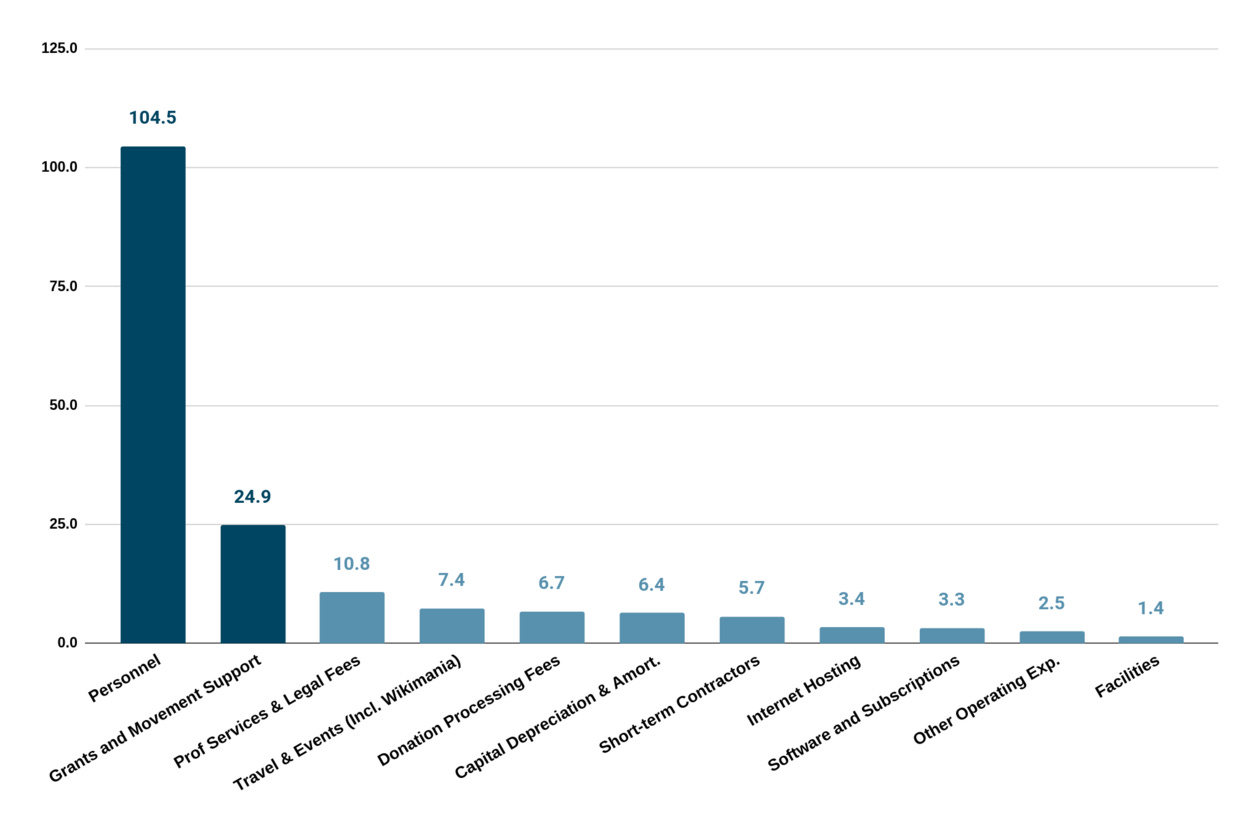
Meanwhile, WMF revenue has grown by 50% over the past five years alone—excluding the Wikimedia Endowment, which has $140 million in separate funds. Something has to be done with all that money. And while WMF also gives money to other NGOs, a significant portion of it is now going to the executive team.
At what point does the community of volunteer editors decide the “too much is not enough” approach to compensation has gone too far? That remains to be seen.
Editor’s note: NPOV does not have a $200 million budget. We need support from readers like you. Please subscribe to help us continue to do independent journalism.
Excellent exposé. Your coverage of Wikipedia is spot on!