

Editor’s Note: NPOV is growing fast, but we rely on the support of readers like you. Please consider a paid subscription to help us continue exposing narrative attacks like the one against Max.
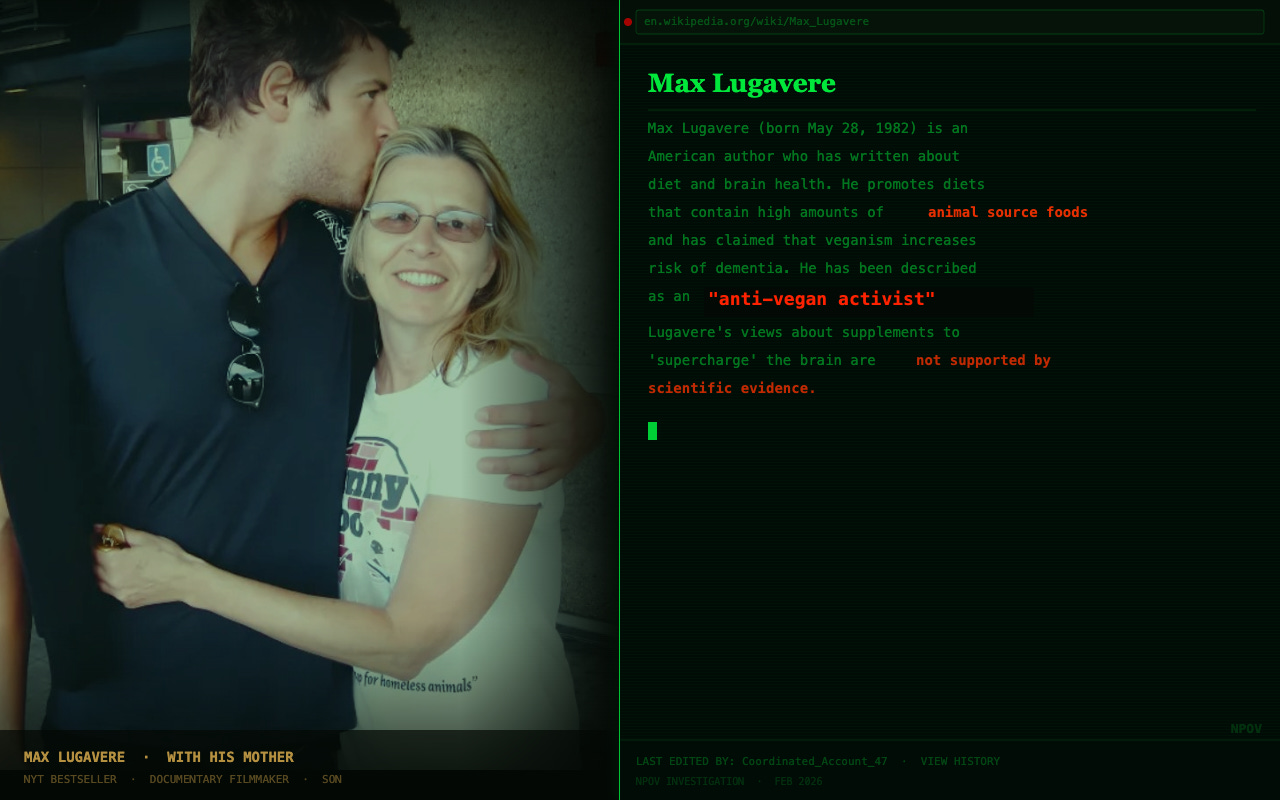
Max Lugavere is a health and science journalist, New York Times bestselling author, and host of The Genius Life, a podcast with more than 80 million downloads. He is the author of Genius Foods, The Genius Life, and Genius Kitchen, and co-director of Little Empty Boxes, a documentary about his mother’s battle with dementia and the emerging science around cognitive decline.
His work began with a personal crisis.
In an interview with NPOV Chief Investigative Officer Ashley Rindsberg, Lugavere explains that his mother developed Lewy body dementia when Lugavere was in his late twenties. “My mom was the most important person in my life,” he said.
Trained as a journalist rather than a clinician, he approached the diagnosis the only way he knew how—a deep journalistic dive into the scientific literature.
“Because this was the most important thing happening in my life, I decided to take it upon myself to investigate why this was happening to my mom,” he told NPOV. “I had tools at my disposal that I felt few others had. I had media credentials. I started reaching out to scientists around the world to try to understand the risk factors.”
What followed was years of reporting across neurology, nutrition, and metabolic health. That work eventually became Genius Foods, which he wrote while unemployed, treating it as a full-time project.
“I saw it as an opportunity to pay homage to my mom, to memorialize what she was going through, and to pay homage to the science,” he said.
This experience became the foundation for his books and documentary: an attempt to understand whether cognitive decline is inevitable, or whether risk can be meaningfully reduced.

But that’s not what visitors to Lugavere’s Wikipedia page—or users who search his name on Google, which pulls from that page—will learn. Instead, readers encounter a manipulative framing mechanism in the first sentences of the entry:
“Max Lugavere (born May 28, 1982) is an American author who has written about diet and brain health. He promotes diets that contain high amounts of animal source foods and has claimed that veganism increases risk of dementia. He has been described as an ‘anti-vegan activist’. Lugavere’s views about supplements to ‘supercharge’ the brain are not supported by scientific evidence.”
Before Wikipedia mentions Lugavere’s books, his documentary, his journalism, or his mother’s illness, it frames him as someone who promotes meat-heavy diets, advances unsupported claims, and functions as an “anti-vegan activist.”
That phrase is the most damaging element in the lead—and an immediate red flag that there’s a reputational attack at work. This single phrase, coming at the end of the lead (where adversarial editors frequently add the most potent, damaging material) recasts a journalist whose work emerged from personal tragedy into an ideological actor, and it does so in the section that gets reproduced by Google, referenced by AI systems, and read by academics, journalists, and curious readers looking for more background.
Watch: NPOV’s interview with Max Lugavere
The Adversarial Framing
The characterization of Lugavere as an “anti-vegan activist”—not a journalist or health writer—comes not from a medical body, professional association, or even a summary of a broad review of the literature. Rather, it comes from a single institutional pipeline tied into a vast, coordinated Wikipedia editing and manipulation effort.
The editor responsible for inserting and enforcing this language is the account now known as Carrot juice. Wikipedia’s rename log shows that this account previously operated under the names Veg Historian and, before that, Psychologist Guy.

According to the user’s own page, Carrot juice founded WikiProject Veganism and Vegetarianism and participates in WikiProject Animal Rights. Wikipedia data analysis tools show that Carrot juice is the dominant contributor to Lugavere’s biography, responsible for roughly half of the article’s content and for the largest individual insertions during the period when the current lead paragraph took shape. It was Carrot juice, then operating as Veg Historian, who inserted and elevated the criticism into the opening sentences and introduced the sourcing that labels Lugavere an “anti-vegan activist.”
On the Talk pages, Carrot juice, then operating as Psychologist Guy, has often taken a confrontational, prosecutorial tone. This includes framing contested dietary claims as conclusively “fringe,” escalating disputes with allegations of bad faith, sockpuppetry, and canvassing. The user has also been involved in edit-warring reports, NPOV noticeboard discussions, and has been accused by another editor of harassment.
Lugavere went so far as to make an emotional appeal on Wikipedia, but received no meaningful response.
Network Origin Point
A look at the dynamics behind this narrative attack tells a deeper story.
The main citation for Wikipedia’s attack on Lugavere is a 2018 article by Jonathan Jarry titled Brain Health: Max Lugavere and the Bait-and-Switch Maneuver, published by McGill University’s Office for Science and Society (OSS).
In that piece, Jarry writes that Lugavere “lacked the credentials to accurately interpret the scientific literature,” characterizes him as a “naive believer in anything that has a study behind it,” and emphasizes endorsements from Dr. Oz and Mark Hyman to suggest guilt by association.
These lines are lifted directly into Lugavere’s Wikipedia article and form the basis for its opening claims that his views are not supported by science.
User:Carrot juice (formerly Veg historian- Psychologist Guy) does not stop there, but reinforces this framing by citing a second the same institution as Jarry. In fact, it’s Jarry’s boss, OSS co-founder and director, Joseph A. Schwarcz, whose writing is also used by the Carrot juice as a key part of the narrative framework.
Wikipedia presents these as independent expert assessments. Both authors operate inside the same advocacy unit. OSS is a science communications office devoted to public-facing interventions around—what it defines as—misinformation. Jarry has described his role as involving coordination with journalists and deliberate amplification designed to produce reputational pressure.
In an interview with Skeptical Inquirer (more on that publication later), Jarry explains how OSS gathers data, feeds reporters, and escalates narratives across media platforms to influence outcomes. Despite this explicitly interventionist posture, OSS commentary is treated by the editor, and by extention, Wikipedia, as a neutral medical authority.
A Coordinated Edit Ring
What emerges from Lugavere’s case is not a dispute between individual editors. It reflects the activity of a long-running, organized faction inside Wikipedia that refers to itself broadly as the Skeptics—a network of editors, writers, and institutional affiliates who coordinate across Wikipedia, advocacy organizations, and sympathetic media to shape how health, science, and public figures are presented online.
The Skeptics are not ideologically neutral (their political activity is extensive). They operate as a disciplined editorial bloc, controlling or heavily influencing thousands of articles across medicine, nutrition, psychology, geopolitics, and biographies of living people. Their footprint appears repeatedly in Wikipedia governance venues, arbitration discussions, and “fringe” enforcement forums, where they determine which subjects are deemed legitimate and which are framed as pseudoscience or activism.
This network functions through formal projects such as Guerrilla Skepticism on Wikipedia (GSoW), through WikiProject Skepticism and related noticeboards, and through external platforms including Skeptical Inquirer and its parent body, the Committee for Skeptical Inquiry. Its members write the critical articles, author the Wikipedia pages that establish institutional authority, and then deploy those sources against living subjects — creating a closed editorial loop that presents itself publicly as decentralized consensus.
This structure has existed for years. Internal skeptic communications and early Wikimedia-era discussions describe a deliberate strategy: cultivate “trusted” editors, establish specialist authority, override democratic editing when necessary, and propagate approved narratives across large numbers of articles. Many of the same actors also publish in mainstream or semi-mainstream outlets, which are then recycled back into Wikipedia as “reliable sources.”
It is within this context that a key Skeptic operator, User:Robincantin, enters the picture. While not directly active on Lugavere’s entry, Robincantin is central to the activities of the group.
Robincantin created Jonathan Jarry’s Wikipedia biography in 2023 and remains its top contributing editor by authored text. Jarry did not have a Wikipedia article prior to Robincantin creating one, and it’s not clear that Jarry would have independently met Wikipedia’s notability standard.
But Robincantin’s editing doesn’t stop with Jonathan Jarry. The editor also serves as the primary author of the McGill Office for Science and Society Wikipedia page itself, and is the second-ranked author on the page on the OSS’s co-founder and director, Joseph Schwarcz.
In practical terms, the same editor built the institutional profile of OSS, created the Wikipedia entry on OSS’s lead communicator, and operates within the skeptical editing ecosystem that applied OSS material to Lugavere’s biography.
The Media Layer
This connection is not incidental. In a Skeptical Inquirer interview, Susan Gerbic refers to Robin Cantin directly as “my editor,” placing him inside the operational core of Guerrilla Skepticism rather than at its periphery.
Gerbic is not only the founder of Guerrilla Skepticism on Wikipedia. She is also a Fellow of the Committee for Skeptical Inquiry, which owns Skeptical Inquirer, and she is a regular columnist for the magazine.
Authorship data shows Gerbic as the second-ranked editor on Wikipedia’s Skeptical Inquirer article by character count, meaning a founder of GSoW directly helped author the encyclopedia entry for the publication she writes for.
The overlap is even more pronounced on the Wikipedia article for the Committee for Skeptical Inquiry itself, where Gerbic is the top contributing editor, responsible for roughly 38 percent of the article’s authored content. (By comparison, the second-ranked editor accounts for under seven percent.)
Gerbic effectively constructed Wikipedia’s representation of the organization she is a Fellow of and that owns Skeptical Inquirer.
Taken together, the structure becomes visible:
Robincantin builds Jonathan Jarry’s Wikipedia biography and the Wikipedia page for McGill’s Office for Science and Society.
Jarry produces the OSS critique of Lugavere. Schwarcz reinforces it.
Carrot juice inserts that material into Lugavere’s lead paragraph and enforces the framing.
Guerrilla Skepticism network serves as a coordination mechanism.
Skeptical Inquirer provides a media platform where many of the same figures write, edit, or are interview subjects.
Gerbic authors or controls Wikipedia entries for both Skeptical Inquirer and its parent organization.
(NPOV has reached out to Schwarcz, Jarry, Gerbic and Skeptical Inquirer for comment.)
”Everything we put out can be used by anyone, so if someone wants to use some of our it in biographies it is fine with me,” Schwarcz told NPOV. “We stand behind everything we put out. We have no formal relationship with any organization including Guerilla skeptics but xI do approve of what Susan Gerbic does.”
The Attack Deepens
The same editorial pattern appears toward the end of Lugavere’s Wikipedia entry in the treatment of his documentary, Little Empty Boxes.
Rather than summarizing audience reception or the substance of the film, the article selects two negative reviews from highly obscure review outlets and presents them as representative. Wikipedia then summarizes these critiques as evidence that Lugavere’s film promotes questionable science.
There is no mention in the lead that the film took nearly a decade to make, that it centers on Lugavere’s mother’s decline, or that it documents interviews with credentialed neurologists and clinicians. Instead, the documentary is reduced to a handful of hostile lines that align neatly with the broader framing of Lugavere as a fringe health figure.
“They pulled two reviews from random websites and treated that like critical consensus,” Lugavere told NPOV. “Meanwhile, the audience response is overwhelmingly positive. That doesn’t appear anywhere.”
One of the reviews cited on Wikipedia accuses Lugavere of exploiting his mother’s illness to sell supplements, a claim Lugavere says is not only false, but grotesque.
“The supplements aren’t even mentioned in the film,” Lugavere told NPOV. “They play zero role in the narrative. The movie is about my mom. It’s about dementia. It’s about prevention. To suggest I used her illness to sell products is absolutely insane.”
The Reputational Effect
A journalist whose work grew out of watching his mother decline from dementia is introduced primarily through claims about animal products and veganism. A bestselling author and documentary filmmaker is recast as an ideological activist. His academic contributions are absent from the lead. His motivation is erased. His work is filtered through the lens of a single advocacy office and enforced by editors embedded in coordinated skeptic networks.
Each step is procedurally defensible in isolation. Together, they transform a living person’s public record.
This matters because Wikipedia no longer functions solely as a reference site. Its content feeds Google knowledge panels, informs journalists, trains large language models, and underwrites fact-checking systems. When coordinated activist networks can construct sources, elevate those sources, and deploy them against living people inside the same platform, the consequences extend far beyond any single biography.
Lugavere’s case provides a clear, documented example of how that system operates.
A health journalist whose career began with watching his mother fade from dementia is recast online as a fringe ideologue through an editorial pipeline most readers will never see. They will simply assume Wikipedia got it right.