


Wikipedia has a serious bias problem—and it’s getting worse. For over a year, I’ve reported on what I’ve taken to calling the “Wikipedia Crisis.” Broadly, this refers to a matrix of serious issues that have turned the site’s most sensitive topic areas—American politics, Palestine-Israel, COVID, gender identity—into hot spots of ideological editing, turf wars, and outright propaganda.
Wikipedia co-founder Larry Sanger recently released his "Nine Theses” outlining what he believes to be the root of these issues. After giving his Nine Theses a close read, I interviewed Larry in a lengthy sit-down, and am fully convinced he hit the nail on the head—nine times. (The full interview will be available to NPOV subscribers in the next few days.)
One of the issues Larry has spoken about is persistent leftwing bias on Wikipedia. While this might sound like a great sound bite (which it is), the reality is that it’s fully backed up by quantitative research.
In 2024, David Rozado (a leading machine learning researcher I’ve had the privilege of working with) published a study on just how pervasive Wikipedia’s bias really is. Rozado concluded from his research that “Wikipedia’s neutral point of view policy (NPOV) is not achieving its stated goal of viewpoint impartiality in Wikipedia articles.”
The power of Rozado’s research lies in his sound methodology and the visually represented nature of his findings. Take a look at the graphs below, which show the sentiment (on the y axis) found in Wikipedia articles associated with political figures from the Democratic Party (represented in blue) and the Republican Party (represented in red).
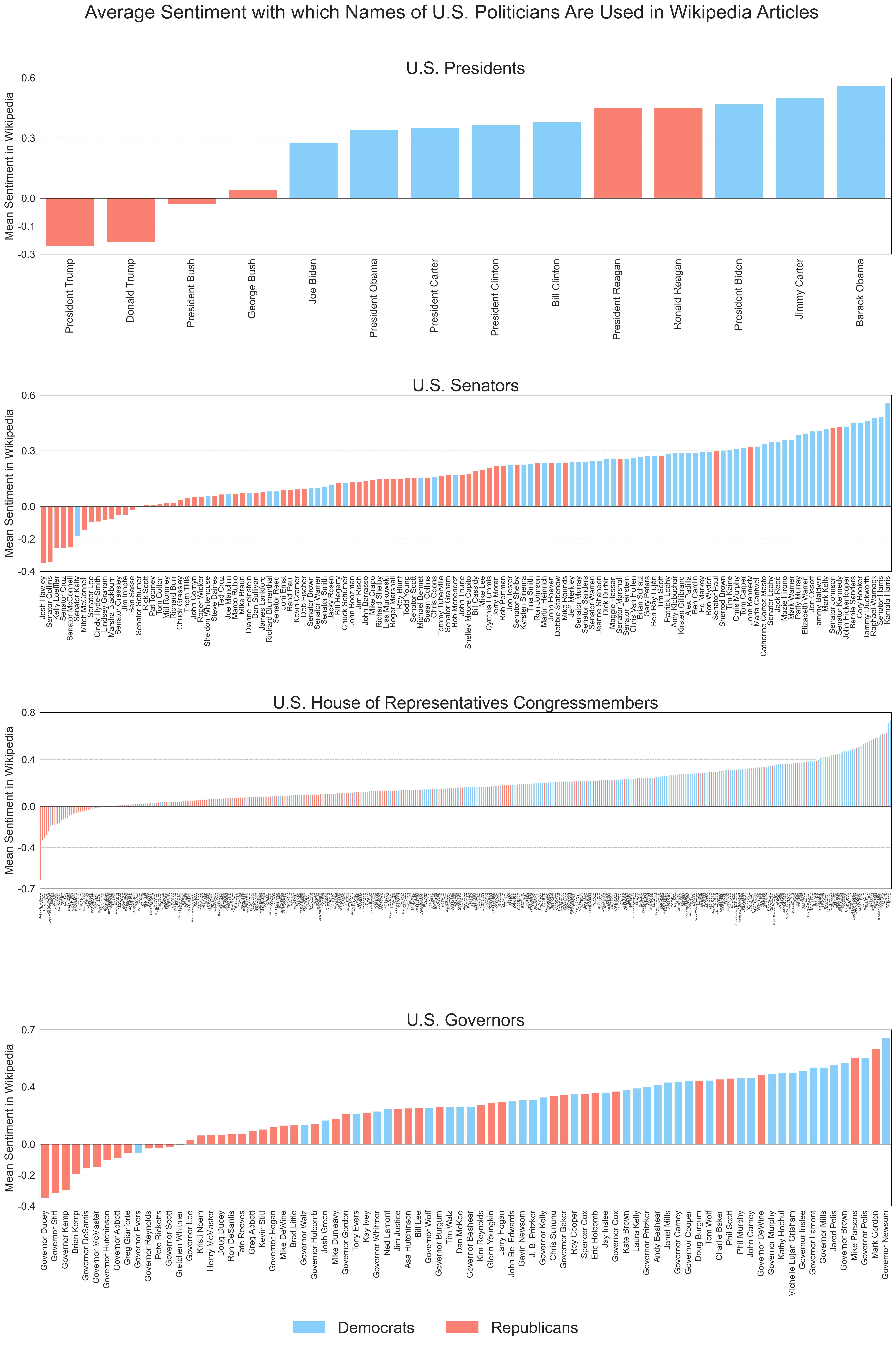
The correlation is clear: Democratic, or blue, politicians are much more frequently associated with positive sentiment than their Republican counterparts. Conversely, Republican politicians are much more frequently associated with negative sentiment. This applies to American presidents, members of the House of Representatives, senators, governors, and even Supreme Court Justices.
Strikingly, the same pattern applies to American journalists. Journalists on the right, like Tucker Carlson, Rich Lowry, Bill O’Reilly, and Stephen Hayes are associated with negative sentiment on Wikipedia. Left-wing journalists like New York Times columnists Thomas Friedman and Nicholas Kristof, as well as CNN’s Anderson Cooper and Christiane Amanpour, and Arianna Huffington (who has the second highest sentiment score on the entire chart) are associated with strongly positive sentiment in Wikipedia articles.
The left-wing bias isn’t limited to the US. Rozado writes:
”The phenomenon described above is not circumscribed to American public figures. A similar trend is also observable in the way that Prime Ministers (since the year 2000) from prominent Western countries are used in Wikipedia articles. This pattern however is not apparent when examining Wikipedia mentions of U.K. MPs.”
There are many reasons for this, each serious in its own way. The first is that, as I’ve explained before, Wikipedia functions as a “wrapper” for the mainstream media. It bases its statements of fact on what the media—New York Times, CNN, CBS, ABC, NBC, Politico, New Yorker, Axios, etc—report. The idea that these outlets report more favorably on Democratic figures compared with Republicans is no longer controversial.
The other reason is bias on Wikipedia itself. In the words of Larry Sanger, Wikipedia’s co-founder, Wikipedia is shaped by what he calls a GASP perspective: Globalist, Academic, Secular, Progressive. Anyone who’s dived deep into the bowels of the site (or just carefully skimmed its surface) knows how true this is. That the GASP framework would lead to a leftward skew on the site is almost true by definition.
Whatever the cause, it’s clear that Wikipedia has a bias problem. The site’s defenders can argue the issues one by one—”COVID almost certainly came from an animal”; “Trump shows fascist tendencies”—but what can’t be argued is that measured sentiment associated with left-wing figures is much better than that associated with rightwing figures. And this is precisely what Rozado has shown to be true.
In the next few weeks, we’ll have some explosive reporting, including major investigative reports, coming out on Wikipedia bias.
This reporting will show the extent to which Wikipedia bias warps our information ecosystem—and how easily bad actors can hijack not just individual articles but entire topic areas.
If you haven’t subscribed, please do. If you have, you’d be helping us immensely by forwarding this article to two people you know.
Its not "just" left wing bias.
Its also "science" bias.
If big pharma advocate any line on absolutely anything..Wikipedia will promote and guard it.
It also tries to hold the "consensus" line on consciousness .
PSI WARS: TED, WIKIPEDIA AND THE BATTLE FOR THE INTERNET
by Craig Weiler (
Educators take note. This highlights the importance of disregarding Wikipedia as a reliable, academic source.