
Wikipedia's Porn Roots
The intersection of porn stars and the journalist who didn't kill JFK

One of Wikipedia’s most powerful trust-building tools over its 20-year history has been its ability to tell an amazing story. This is the story of a new, crowdsourced approach to knowledge, one that leverages the connectivity of the internet to produce neutral articles on important topics.
No one has done a better job of telling this story than its co-founder Jimmy Wales. For the past two decades, Wales has told this story in thousands of venues, across dozens of formats, from TED Talks to sit-down interviews to blog posts.
What gets left out of every instance of this story-telling, however, is one important part of Wikipedia history. Before Wales co-founded Wikipedia, he ran a website called Bomis.com, an early internet site that featured the first iteration of an online encyclopedia, called Nupedia. Bomis struggled to find its footing until it hit on a not-quite-novel idea: put porn online. Bomis featured a section called “Bomis Babes” and also maintained a separate URL, Nekkid.com. You can still see the sites on archive.org. (Warning: NSFW.)
People have differing views on the social and ethical value of profiting off of porn. That’s okay, even in the context of Bomis revenue being used to launch Wikipedia. What’s more troubling, however, is what came after.
Over the course of more than a year, Wales edited his own Wikipedia article to remove any reference to the term pornography. This was done in violation of Wikipedia’s core principles, including Wikipedia:Neutral point of view (aka NPOV), and, just as importantly, Wikipedia:Conflict of interest. The latter policy expressly forbids:
“contributing to Wikipedia about yourself, family, friends, clients, employers, or your financial and other relationships.”
In Wales’ case, however, the rule did not apply. In March 2005, as Wikipedia began getting major traction, Wales wrote on the Talk page of his article that he “was *this close* to editing this article myself, but decided that my longstanding ban on editing myself is a good thing overall.”
That seems like a good idea, considering Wikipedia’s COI rule. But just a few months later, Wales did exactly what he’d pledged not to do. In August, he removed a sentence from his article that identified him as a majority shareholder in Bomis as of 2005.
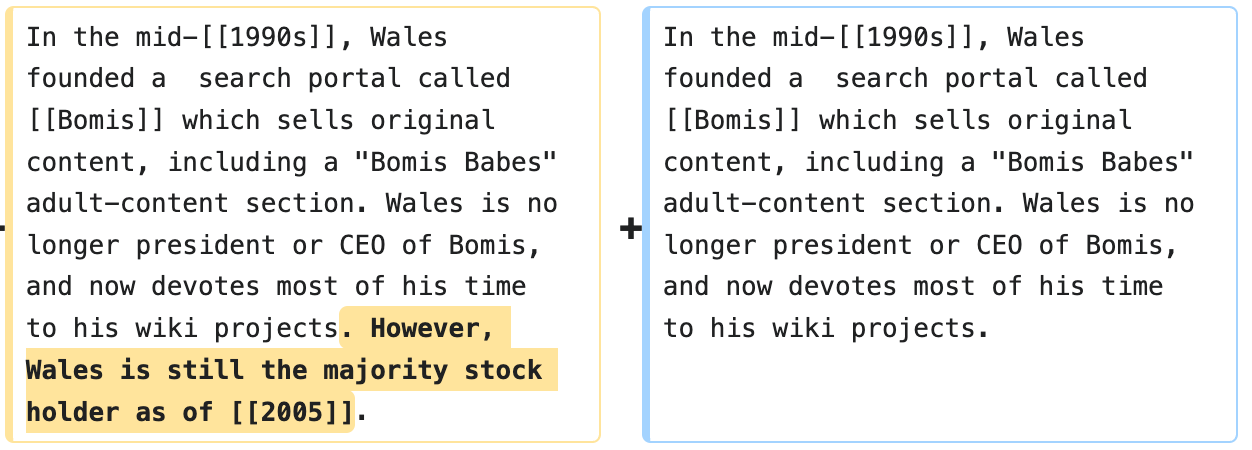
Weeks later, Wales again violated his own “longstanding ban on editing [himself]”—and Wikipedia’s own policy against such editing—when he changed a reference to Bomis’ content from “softcore pornography” to “adult content.”
The original sentence read:
In the mid-1990s, Wales founded a search portal called Bomis which sells original content, including a ‘Bomis Babes’ softcore pornography section.
Wales edited the sentence to read:
In the mid-1990s, Wales founded a search portal called Bomis which sells original content, including a “Bomis Babes” adult content section.
The self-editing, however, did not stop there. Wales continued to chip away at this claim, which he evidently found damaging. Six weeks after changing the reference from “softcore pornography” to “adult content,” Wales made another edit, this time removing any mention of the content type at all, and replacing it with a somewhat irrelevant technical detail about Bomis’ blogging software.
The edited sentence read:
In the mid-1990s, Wales founded a search portal called Bomis which sells original content, including a “Bomis Babes” blog based on Slashcode.
Wikipedians Respond—“Highly Unethical”
This didn’t go unnoticed by rank-and-file Wikipedians. Responding to claims by another editor that people upset about Wales self-editing were “two bit trolls,” user Matt Gies responded:
Hey, you’re barking up the wrong tree here. I love the porno. What I hate is deception, obfuscation, blind faith, hero-worship, and hypocrisy. I don’t think having made soft porn is bad; I think denying and trying to hide it is bad and highly unethical.
Wales himself jumped into this thread with an astonishing claim: it wasn’t porn at all. In the thread, he argued that the claim the “Bomis Babes” section constituted softcore porn was “ludicrously pov” [point of view], and argued that the images were “glamour photography.”
A quick glance at these highly graphic, sometimes shocking images makes Wales’ claim about “glamour photography” sound patently absurd. In fact, as views of pages featuring softcore porn began dropping, Bomis began linking to hardcore pornography—a far cry from “glamour photography.”
“What I hate is deception, obfuscation, blind faith, hero-worship, and hypocrisy.”
Wales then argued that the claims shouldn’t have been included in the article at all since there were no media sources backing them up. (The mere existence of the Bomis Babes section obviously did not meet the bar of reliability.)
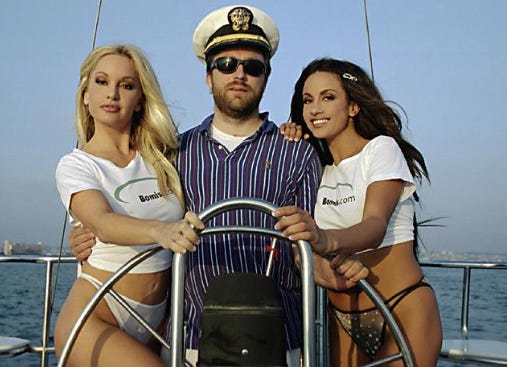
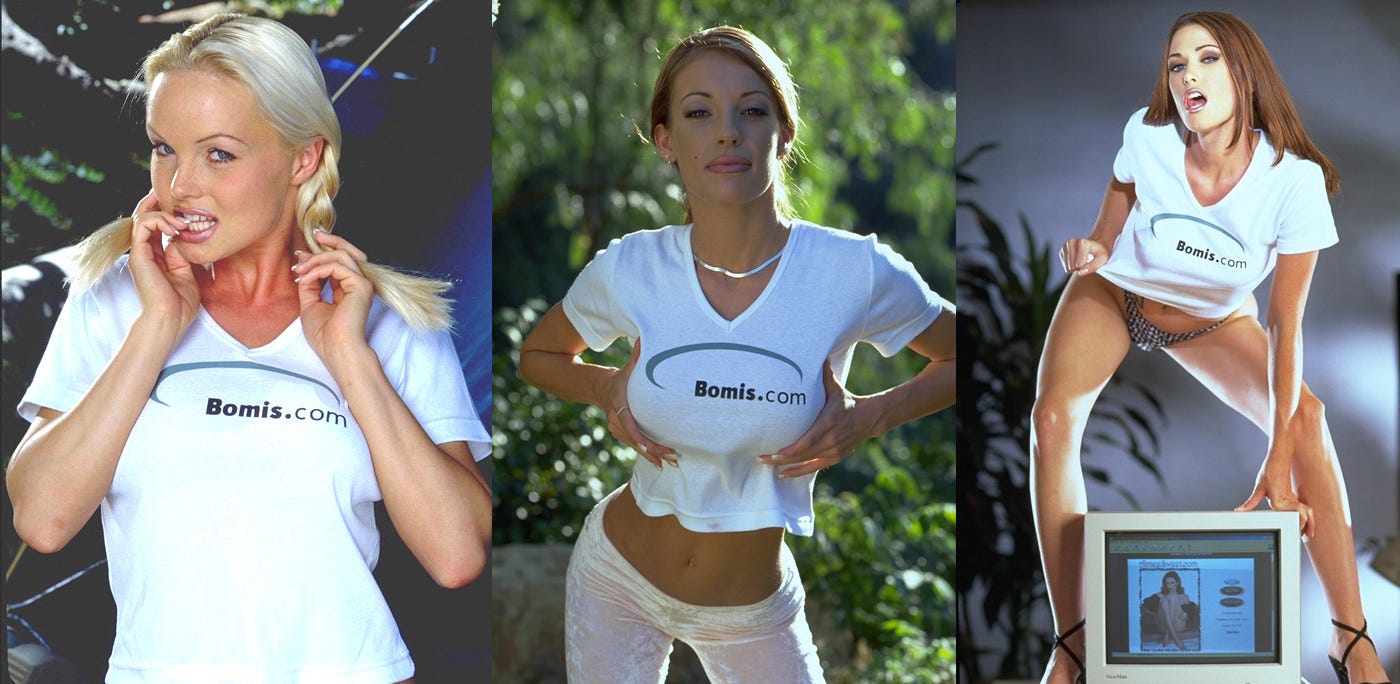
Despite his protestations, Wales expressly marketed Bomis as a porn site, going so far as to pose with two porn stars, each wearing a Bomis.com t-shirt, for a company photoshoot. He also hired models to market the company as such in at least two other photoshoots.
The Man Who Didn’t Kill Kennedy
While Jimmy was editing his own Wikipedia article to remove mention of his porn website that had, in fact, existed, a few hundred miles west of Wikipedia headquarters in St. Petersburg, Florida, another man was dealing with his own Wikipedia crisis. In May 2005, an unregistered Wikipedia user added a sentence to the John Seigenthaler Sr., the then-78-year-old former editor of The Tennessean newspaper:
For a brief time, he was thought to have been directly involved in the Kennedy assassinations of both John, and his brother, Bobby. Nothing was ever proven.”
This, of course, was a lie. Seigenthaler had worked for Bobby Kennedy in the 1960s. He was also a pallbearer at Mr. Kennedy’s funeral. Needless to say, he had nothing to do with Kennedy’s assassination.
Despite this, the lie remained on Seigenthaler’s Wikipedia article for months. Not only that, but it spread to other websites, including Reference.com and Answers.com. It required Seigenthaler drawing on his considerable social capital as a well-known editor to get the lie removed from the article.
Seigenthaler wrote about the experience:
Wikipedia’s website acknowledges that it is not responsible for inaccurate information, but Wales, in a recent C-Span interview with Brian Lamb, insisted that his website is accountable and that his community of thousands of volunteer editors (he said he has only one paid employee) corrects mistakes within minutes.
My experience refutes that. My “biography” was posted May 26. On May 29, one of Wales’ volunteers “edited” it only by correcting the misspelling of the word “early.” For four months, Wikipedia depicted me as a suspected assassin before Wales erased it from his website’s history Oct. 5. The falsehoods remained on Answers.com and Reference.com for three more weeks.
As Wales was scrubbing unfavorable but entirely accurate facts from his own article, a journalist with a five-decade-long career behind him had to pull strings to get libelous lies about him removed from his own article. In attempting to pursue justice, Seigenthaler learned that Section 230 of the Communications Decency Act of 1996 would shield both Wikipedia and the internet service provider of the individual who libeled Seigenthaler from any accountability.
Wikipedia depicted me as a suspected assassin
This would become a template for how Wikipedia would be used not just as an attack vector, but as a tool for propaganda.
Seigenthaler concluded his account of this experience by writing:
When I was a child, my mother lectured me on the evils of “gossip.” She held a feather pillow and said, “If I tear this open, the feathers will fly to the four winds, and I could never get them back in the pillow. That’s how it is when you spread mean things about people.”
For me, that pillow is a metaphor for Wikipedia.
Whoa